

The wire harness industry is growing as vehicles, factories, aircraft, and connected equipment require more power and signal routing. Market estimates vary because research firms define the category differently. Still, the direction is clear: electrification is raising harness complexity, while large manufacturers are adapting their footprints and portfolios. This guide explains the 2026 market picture, identifies 10 major manufacturers, and shows where a custom producer fits.
How Big is the Wire Harness Market in 2026?
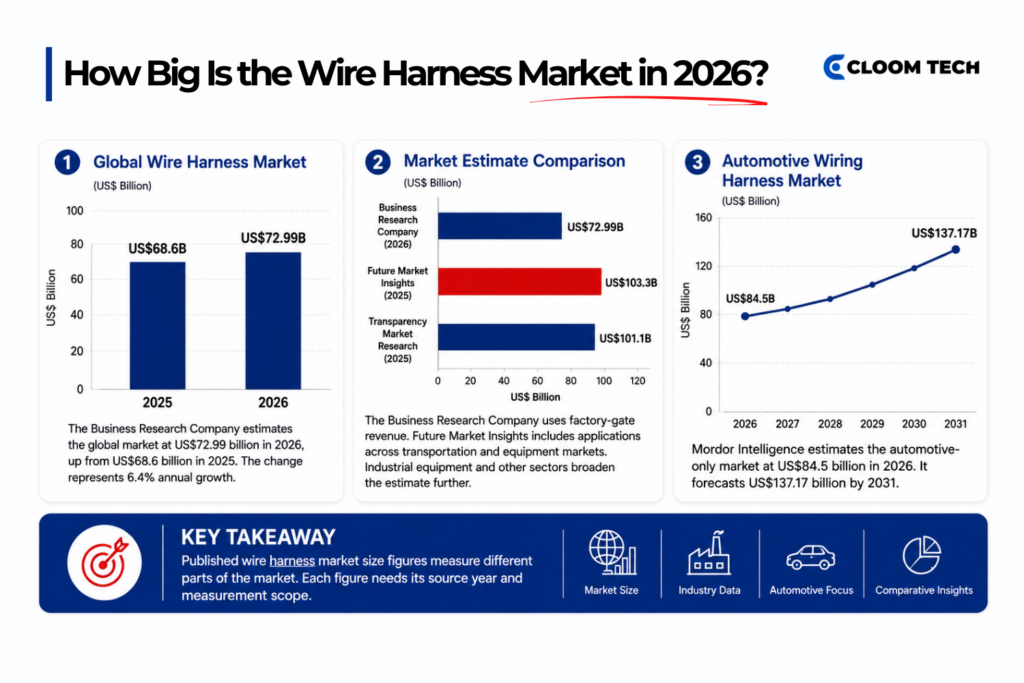
Published wire harness market size figures measure different parts of the market. Factory-gate estimates count completed products when manufacturers sell them. Broader reports may include more product categories and end-use sectors. Each figure needs its source year and measurement scope.
The 2026 Global Estimate
The Business Research Company estimates the global market at US$72.99 billion for 2026, up from US$68.6 billion in 2025, representing 6.4% annual growth.
Its estimate uses factory-gate values. A factory-gate value measures the revenue manufacturers receive for completed products. It excludes downstream markups added after the product leaves the producer.
Why Published Estimates Differ
Future Market Insights values the market at US$103.3 billion in 2025. It forecasts US$152.9 billion by 2035. Transparency Market Research places the 2025 market at US$101.1 billion. The Insight Partners projects US$150.70 billion by 2030.
None of those sources places the market above US$150 billion in 2026. The figures cover different forecast periods and research models. Averaging them would combine separate datasets and create an unsupported total.
The Business Research Company uses factory-gate revenue. Future Market Insights includes applications across transportation and equipment markets. Its scope covers automotive and aerospace. Industrial equipment and other sectors broaden the estimate further.
The Automotive-Only Estimate
The automotive wiring harness market uses a separate measurement. Mordor Intelligence estimates the automotive-only market at US$84.5 billion in 2026. It forecasts US$137.17 billion by 2031.
Automotive remains the largest application category. This market value represents only one industry segment, not the entire wire harness industry. Buyers should compare the Mordor figure with other automotive studies instead of treating it as a global total.
What is Driving Growth?
Demand is increasing through higher vehicle electrical content and industrial automation. Aircraft production adds another long-term source of orders. Material prices affect the reported value of that demand. Each driver changes harness specifications or production costs through a different mechanism.
Vehicle Electrification
Battery and hybrid vehicles carry 1.5–2.0 times the harness content of combustion vehicles. Plug-in hybrid platforms follow the same pattern.
Higher harness content comes from battery connections and charging circuits. High-voltage power distribution adds another electrical network alongside the vehicle’s low-voltage system. Each network needs conductors sized for its current load and voltage class.
Higher current increases conductor heating. Engineers may need a larger conductor when ampacity or voltage-drop calculations exceed the selected gauge’s limits. Higher voltages place greater demands on insulation and separation between conductive parts.
Mordor Intelligence forecasts a 16.98% compound annual growth rate for its high-voltage harness segment between 2026 and 2031. Its public summary does not assign the rate to a geographic market. The report identifies charging and power-supply harnesses as its fastest-growing automotive product group.
Global electric-car sales exceeded 17 million in 2024, accounting for more than 20% of all cars sold worldwide. Rising sales expand the electric vehicle wiring harness market through greater production volumes. Added electrical content increases harness value per platform.
Industrial Automation
Manufacturers installed 542,000 industrial robots in 2024. The installations raised the global operating stock to 4.664 million units.
Robots and automated cells need wiring systems that carry power and control signals through repeated movement. An industrial wire harness may need flex-rated conductors when the application bends during every operating cycle. Bend radius and strain relief control how mechanical loads reach the conductor and terminal.
Vibration creates another design constraint. Repeated movement can load crimp points or connector interfaces when the harness lacks proper support. Routing and protective sleeving help control movement within the machine.
Aerospace Production
Airbus delivered 793 commercial aircraft in 2025. The manufacturer ended the year with an 8,754-aircraft backlog.
Aircraft require electrical wiring interconnect systems for onboard equipment and cabin systems. Weight limits affect conductor size and protective materials. Routing must fit the allocated space without creating unsupported spans or interference points.
Conductor size must still meet current and voltage-drop requirements. Engineers cannot reduce the gauge solely to save weight. Each material decision must balance electrical load with the aircraft’s mass limits.
Copper Prices
Copper accounts for a major portion of conductor cost. A price increase can raise harness revenue even when production volume changes by a smaller amount.
Furukawa Electric cited higher copper prices as one contributor to its FY2025 sales growth. Procurement teams should separate volume growth from revenue changes caused by raw-material prices.
Copper movements can affect supplier quotations during long programs. Buyers may need defined quote-validity periods or material-adjustment terms. Those controls keep pricing aligned with the conductor cost used in production.
Market Segments
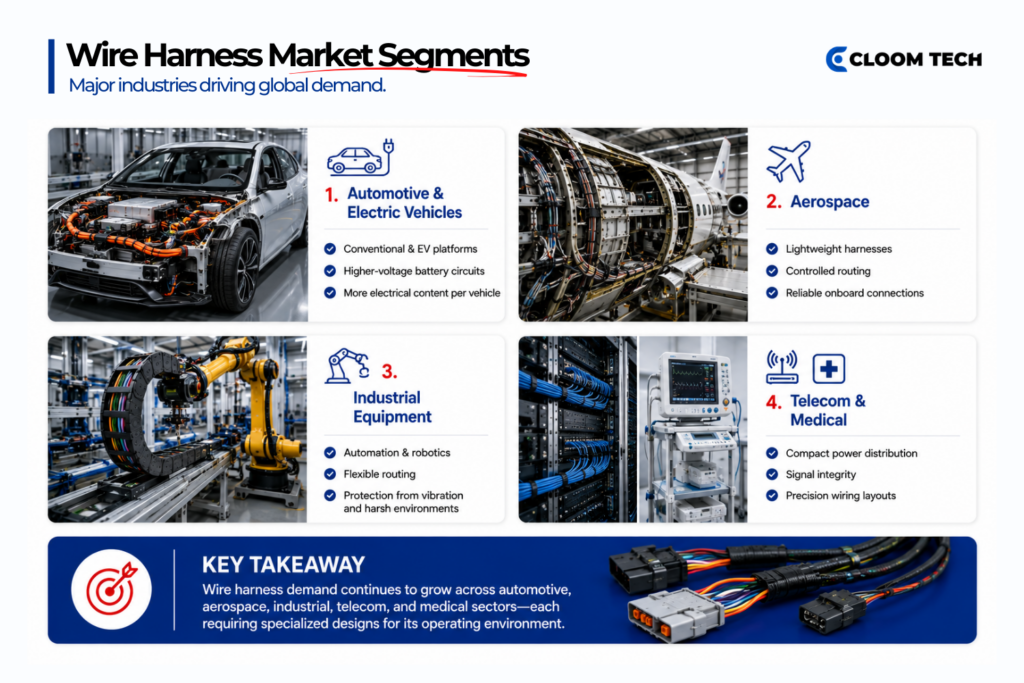
The wire harness industry serves applications with different voltage levels and operating environments. Automotive programs emphasize platform volume and electrical content. Aerospace projects place greater pressure on weight and routing. Industrial equipment adds motion or vibration requirements.
Automotive and Electric Vehicles
A modern vehicle can contain about 40 harnesses and 3,000 wires. It may use 700 connectors and roughly five kilometers of cabling, according to The Insight Partners.
The assemblies distribute power and carry control signals between vehicle systems. Platform voltage and circuit count determine the architecture. Available packaging space controls how engineers divide the wiring into separate harness assemblies.
The automotive wiring harness market includes conventional low-voltage systems and electrified architectures. An electric vehicle adds battery circuits and charging paths. Power-distribution connections must carry higher loads than many conventional signal circuits.
Higher-voltage systems require insulation rated for the operating voltage and environment. Routing must preserve the specified separation from other systems. Testing confirms continuity and checks each circuit against the approved drawing.
Added circuits increase the technical requirements behind the electric vehicle wiring harness market. Growth comes from greater vehicle production and more electrical content per platform.
Aerospace
The aerospace wiring harness market prioritizes weight control and routing discipline. Electrical wiring interconnect systems must fit defined paths through the aircraft. Harness weight contributes to the platform’s total operating mass.
Conductor size must meet current and voltage-drop requirements. Protective materials must suit the specified operating environment. Terminations need consistent workmanship because repair access may become limited after installation.
Suppliers build completed assemblies for onboard systems and cabin equipment. Motherson Aerospace documents both production areas.
Industrial equipment
Industrial wire harness demand comes from industrial automation and robotics. Construction equipment creates another major application. Agriculture and energy infrastructure add further demand.
Moving equipment may require flexible conductors and controlled routing. Fixed machinery can place more emphasis on vibration resistance and environmental protection. High-mix production suits applications where each machine configuration uses a different circuit layout.
Temperature and chemical exposure can influence insulation selection. Abrasion risk may require conduit or protective sleeving. Connector seals may need to block moisture or contaminants at the interface.
Telecom and medical equipment
Telecom systems use harnesses for compact power distribution and signal connections. Medical equipment requires assemblies built around the device’s approved electrical layout.
Both sectors appear within major market-report definitions. Their inclusion broadens the market beyond transportation. Compact packaging increases the importance of controlled routing and connector placement.
How We Selected the Top 10
No authoritative cross-company revenue ranking was available for 2026. Therefore, we present the list alphabetically instead of assigning first-through-10th positions.
Each company had to meet the following standards:
- Manufacture completed systems: The company must document finished wire harness or wiring-system production.
- Demonstrate international scale: The company must disclose a substantial workforce or production footprint.
- Show sector relevance: The company must serve a major harness application through documented manufacturing capability.
Regional production footprints provide evidence of that international scale. LEONI operates wiring-system facilities across 15 countries, including 11 production units in Morocco. Versigent identifies Morocco and Serbia as major locations within its European footprint.
Cable-only businesses did not qualify. Connector-led companies needed clear proof of completed-harness production.
Corporate status received a separate review. Aptiv separated its former Electrical Distribution Systems business into Versigent on April 1, 2026. Nexans completed the sale of Autoelectric to Motherson in July 2026.
The Top 10 Wire Harness Manufacturers
The following profiles explain each manufacturer’s completed-harness capability and international scale.
DRÄXLMAIER Group
DRÄXLMAIER develops and manufactures complete vehicle-specific wiring systems. Each system includes the electrical components required for the customer’s platform. Its public product description confirms completed-system capability rather than cable-only production.
The family-owned group reported EUR 5.0 billion in 2025 group sales and operates at more than 60 locations. Its strength lies in complete systems for premium automotive programs. Vehicle-specific routing and system integration shape each product.
The operating model matters because premium platforms combine high circuit counts with restricted installation space. DRÄXLMAIER can support that complexity through complete wiring-system production.
Fujikura Ltd.
Fujikura supplies automotive power-distribution systems centered on wire harnesses. Its automotive operations span Asia and Europe. Production bases across the Americas extend that footprint.
A regional network lets Fujikura place manufacturing closer to vehicle assembly operations. Shorter supply routes can improve production coordination for programs serving several markets. The company’s focus remains on completed automotive power-distribution systems.
Fujikura reported JPY 1,182.4 billion in FY2025 consolidated group sales. It employed 50,586 people in March 2026. Both figures cover the wider group, including telecom and electronics operations.
Furukawa Electric
Furukawa Electric produces bundled wire harnesses for power supply and signal transmission. Its range includes EV and hybrid assemblies. Aluminum-conductor products provide another option for weight-sensitive vehicle architectures.
Aluminum weighs less than copper for a comparable conductor volume. Engineers must account for its electrical properties and termination requirements during specification. The material can support vehicle weight targets when the complete connection system suits the application.
Furukawa reported JPY 1,307.6 billion in FY2025 group net sales. Automotive-component growth contributed to that result. The figure covers the wider group, including telecom and data-infrastructure businesses.
Lear Corporation
Lear builds vehicle harnesses for 12–48V low-voltage systems. Its high-voltage capability extends from 60V to 800V. The range places Lear across conventional electrical networks and newer electrified platforms.
Higher-voltage systems require components rated for the specified electrical architecture. Harness construction must support the required insulation and current capacity. Lear’s voltage range gives vehicle manufacturers one supplier across several platform classes.
Lear reported US$23.3 billion in company-wide revenue for 2025 across Seating and E-Systems. Harness operations sit within E-Systems rather than representing the company’s total revenue.
LEONI Wiring Systems
LEONI supplies complex wiring systems and customer-specific cable harnesses for automotive applications. Its manufacturing scope covers vehicle-specific assemblies rather than standard pre-built cables.
The company reported about 95,000 employees in 23 countries. It recorded EUR 3.9 billion in 2025 consolidated sales after excluding its former Automotive Cable Solutions division. The production footprint supports automotive programs across several manufacturing regions.
LEONI’s ownership structure changed during 2026. Luxshare held 74.9% of the company as of April 29, 2026. Current ownership matters when buyers compare LEONI with profiles published before the transaction.
Samvardhana Motherson International
Motherson describes its Wiring Harness business as a global manufacturer of completed harnesses and electrical components. Its operations serve several transport sectors. Equipment applications broaden the division beyond passenger vehicles.
Samvardhana Motherson Automotive Systems Group B.V. reported EUR 1.994 billion in FY2026 Wiring Harness division revenue on a gross divisional reporting basis. The figure applies to Samvardhana Motherson Automotive Systems Group B.V.’s Wiring Harness division, not the listed parent’s consolidated revenue.
Motherson expanded its production network through the 2026 Autoelectric acquisition. The transaction added 22 plants across 11 countries. Added facilities increase the company’s reach across customer production regions.
Sumitomo Electric Industries
Sumitomo Wiring Systems operates within Sumitomo Electric Industries. The operating company manufactures completed wiring harnesses and related components. Its direct disclosure confirms harness production under a dedicated business.
The company reported 256,871 group employees at the end of March 2026. Its workforce demonstrates substantial international operating scale. Parent-company revenue requires separate treatment because Sumitomo Electric serves additional materials and infrastructure markets.
Dedicated harness manufacturing gives customers access to assemblies and related components within the same operating group. The structure supports tighter coordination between component production and completed-system assembly.
Versigent PLC
Versigent is the independent continuation of Aptiv’s former Electrical Distribution Systems business. The separation took effect on April 1, 2026.
Versigent designs and manufactures low-voltage electrical architectures. Its product range extends to high-voltage systems and completed harness assemblies. High-voltage cables support electrified vehicle power distribution.
At year-end 2025, before its Aptiv separation, Versigent reported US$8.818 billion in net sales, 59 facilities, operations in 25 countries, and about 138,000 employees.
Yazaki Corporation
Yazaki produces wire harnesses and power-distribution products for automotive customers. Its range includes control products and connectors used within completed electrical systems. The company’s North American business says it supplies virtually every major automaker.
The customer reach reflects deep integration with global vehicle production. Automaker programs require manufacturing capacity near regional assembly operations. Yazaki’s network supports that production model.
The Yazaki Group reports 148 companies in 46 countries and regions. Its workforce includes 218,566 employees. The footprint supports its position as one of the most established companies in the wire harness industry.
Yura Corporation
Yura produces automotive wiring harnesses and high-voltage electrical components. Its Cheongju facility manufactures high-voltage harnesses. Its Gyeongju site produces completed wiring assemblies.
The Korean plants support Hyundai and Kia production. Direct original equipment manufacturer relationships give Yura a defined role in Korean vehicle supply chains. High-voltage capability connects that role in expanding electric vehicle programs.
Yura reports 20 corporations and 46 business sites across 14 countries. Its public financial disclosures provide less detail than larger listed groups. Manufacturing capability and customer relevance provide stronger evidence for its inclusion than headline revenue.
Where Cloom Tech Fits
Large global suppliers and custom manufacturers serve different production requirements. Global groups focus on long-running original equipment manufacturer programs and high annual volumes. Custom producers support projects that need flexible quantities or several configurations. The buyer’s order profile determines the better manufacturing model.
Custom production requirements
Mordor Intelligence estimates that 91.85% of automotive harness revenue moved through original equipment manufacturer channels in 2025. The largest suppliers build their operations around those programs.
Many buyers need prototype quantities before approving production. High-mix equipment may use several harness configurations within one product family. Changing specifications can create further demand for flexible production.
Cloom Tech manufactures custom wire harnesses and cable assemblies. We support projects across the automotive sector. Our experience extends to robotics and medical equipment. Our project experience includes work supporting Honda, Honeywell, Mahle, and GEELY.
Lead times and material sourcing
We manufacture in China and the Philippines for international customers. Global material sourcing gives you access to components selected for your application. Transparent pricing keeps production costs visible during review.
We can manufacture prototype harnesses in two to three weeks after documentation approval. Mass production takes four to five weeks when your program is ready.
Lead time depends on the approved bill of materials and component availability. Production quantity affects scheduling. Testing requirements can add another step before shipment.
Design for manufacturability reviews
We review pre-existing drawings before production through design for manufacturability feedback. The review can identify material substitutions and cost-reduction opportunities. It can flag production details that affect assembly efficiency.
A review may identify a connector or terminal that creates unnecessary sourcing delays. It may flag routing dimensions that complicate harness assembly. Material recommendations can address cost or operating conditions.
We can recommend material or production changes, but you approve every change before production begins. We do not provide ground-up product engineering or R&D. Our role begins after you supply the approved product design and centers on providing manufacturing feedback and producing the completed assembly.
Quality controls
Our quality framework includes IPC/WHMA-A-620 workmanship requirements. Internal testing and inspection checks the completed harness against your approved drawing. Third-party testing can support projects that require independent verification.
Continuity testing confirms that each terminal connects to the specified circuit. Inspection checks wire placement and connector orientation. Our production team can verify dimensions against the approved drawing.
Every assembly follows your specification. Send us your drawings and expected order volume. We can assess production fit and explain the available build path.
The Global Wire Harness Industry in 2026 FAQs
How big is the global wire harness market in 2026?
The Business Research Company estimates the global market at US$72.99 billion in 2026.
When does the market reach US$150 billion?
The Insight Partners forecasts US$150.70 billion by 2030. Future Market Insights forecasts US$152.9 billion by 2035.
Why do electric vehicles need more harness content?
Battery and hybrid vehicles carry 1.5–2.0 times the harness content of combustion vehicles. Plug-in hybrid platforms follow the same pattern. High-voltage power distribution and charging systems add circuits that conventional vehicles do not require.
Growth in the electric vehicle wiring harness market comes from greater vehicle production and higher harness content per platform.
Which region has the strongest automotive harness demand?
Asia-Pacific held 48.40% of automotive harness demand in 2025, according to Mordor Intelligence. The Business Research Company identified Asia-Pacific as the largest region in its broader market view.
Regional production supports automotive and industrial demand. The aerospace wiring harness market follows aircraft manufacturing programs in a different group of production locations.
Why do current manufacturer lists differ from older ones?
The supplier landscape changed in 2026. For example, Aptiv separated its electrical-distribution business into Versigent, and Nexans completed the sale of Autoelectric to Motherson.
Back to Top: The Global Wire Harness Industry in 2026: Market Size and Top 10 Manufacturers
