

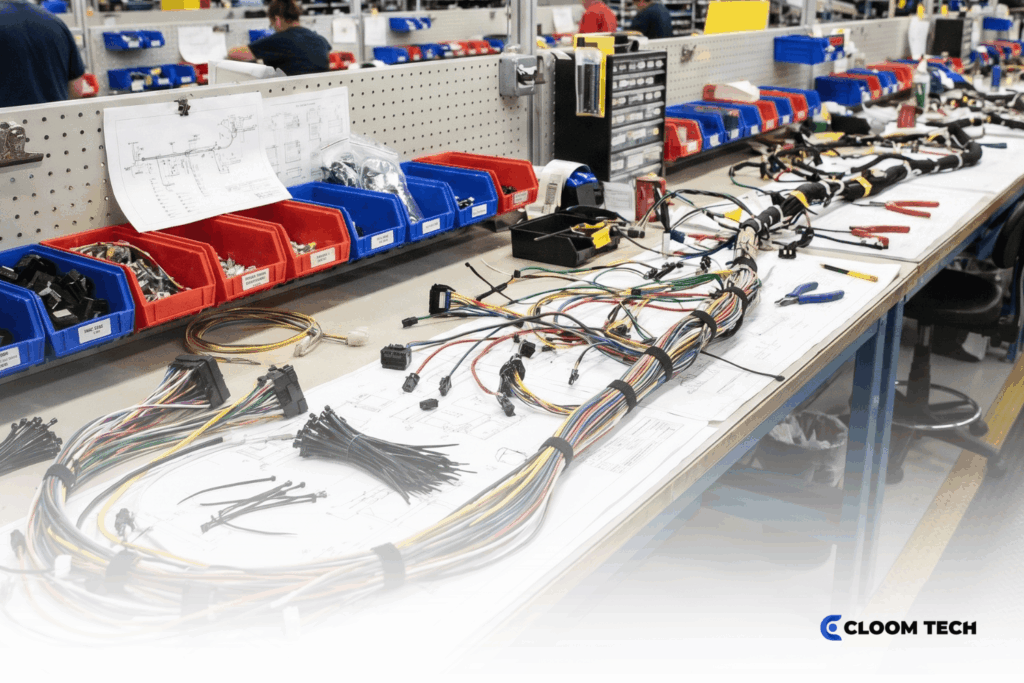
Supply chain risk management for wire harness OEMs means identifying, quantifying, and mitigating vulnerabilities across custom cabling, tier-two component sourcing, and logistics. Without a structured approach, procurement stays reactive – and a single shortage at a tier-two supplier can halt an OEM’s production lines.
Wire harness programs carry four compounding vulnerabilities. Sub-tier dependencies on specialized connectors or wire types from a single source create immediate line-down exposure. Heavy concentration in a single overseas market leaves profit margins exposed to sudden tariff shifts and shipping delays. Late-stage drawing changes and complex proprietary schematics extend lead times and drive rework. Counterfeit or unapproved terminals and splices cause system-level failures, costly warranty claims, and, in regulated industries, potential compliance consequences.
Effective supply chain risk management transitions wire harness procurement from a reactive fire drill to a continuous, resilient strategy. This playbook maps seven wire harness supply chain risk categories and applies four mitigation strategies to each.
Why Wire Harness Supply Chain Failures Are More Costly Than They Look
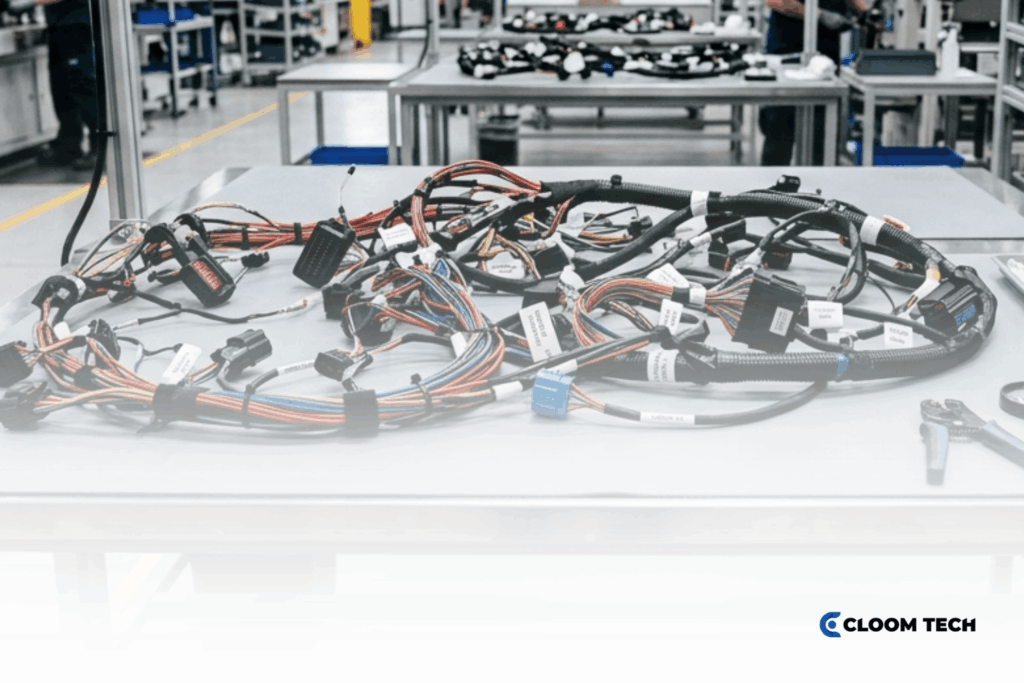
Wire harnesses route power, signal, and control connections across every electrified product assembly. A missing harness blocks all three subsystems simultaneously, making it an immediate line-down part with no interim workaround.
Wire harness supply chain risk compounds quickly because each assembly includes multiple failure nodes. Any single node failing specification triggers rework, scrap, or costly field failures. Each harness assembly carries risk at every component level:
- Copper conductors – price volatility and gauge availability
- Connectors and terminals – vendor concentration and lead-time exposure
- Insulation materials – specialty material dependency and REACH compliance
- High-voltage lines – tighter tolerance requirements for EV and industrial applications
- Shielding and overmolding – supplier-specific tooling and process dependencies
Geopolitical trade restrictions, cross-border tariffs, and proprietary components with no approved alternatives compound the problem. What looks like a simple delivery slip can become a multi-day disruption with regulatory and reputational consequences. Building a resilient supply chain for wire harness procurement means treating each pressure point as a measurable variable in a structured risk framework.
The 7 Risk Categories Every Wire Harness OEM Must Map
Effective supply chain risk management starts with a complete risk map. Wire harness programs span seven distinct categories, each with its own drivers, failure modes, and mitigation requirements.
1. Geopolitical Disruption
Tariffs, sanctions, and export controls create extended lead times when harness inputs source from concentrated regions. OEMs feel this most acutely when proprietary connectors or terminals sit on a short approved vendor list tied to one or two geographies. When a region becomes constrained, full requalification and production part approval process work must complete before volume can shift.
Wire harness supply chain risk from geopolitical disruption materializes rapidly—trade policy changes faster than qualification timelines allow. The highest-exposure programs share these characteristics:
- Approved vendor lists tied to a single country for key connector or terminal families
- No pre-qualified alternates outside the constrained geography
- Long qualification cycles driven by proprietary tooling or customer-specific approval requirements
Procurement teams that monitor geopolitical signals proactively can initiate pre-qualification of alternate sources before a disruption occurs. That preparation shortens recovery from months to weeks, with drawings, samples, and test programs at an alternate facility already in progress when a restriction takes effect.
2. Tariff Exposure
Cross-border harness programs face significant landed-cost swings when tariffs change mid-program. Harness-related Harmonized Tariff Schedule codes similar to 8544.30 have been subject to Section 301 rate increases that shift total landed cost substantially within a single program year.
Buyers who optimize on piece price alone discover the true impact too late. Accumulated tariffs, duties, and customs fees can erode savings and push total costs above those of diversified-origin alternatives. Total landed cost modeling should include:
- Tariff rates at each sourcing origin
- Freight and duties by route
- Inventory carrying costs tied to lead time
- Re-qualification costs if volume must shift
A resilient supply chain accounts for tariff exposure at the sourcing strategy level, not after a rate change hits. Programs that maintain a secondary source in a lower-tariff origin can reallocate volume without qualification delays when a rate change takes effect.
3. Single-Source Concentration
Tooling investments, customer-specific components, and historical qualification decisions frequently leave high-priority harness part numbers with a single approved supplier and a single plant. When that supplier encounters problems, OEMs cannot shift volume quickly—no drawings, fixtures, samples, or test programs will be validated at any alternate facility at that point.
Common triggers for single-source disruptions include:
- Capacity constraints during a supplier’s peak demand period
- Labor instability or facility shutdowns
- Financial distress at the supplier or its key sub-suppliers
- Internal quality failures requiring process holds
The time to qualify a second source under normal conditions is measured in weeks. Under emergency transfer conditions, that timeline stretches considerably longer and carries substantially higher latent quality exposure. Supply chain resilience programs that audit their approved vendor list annually find that single-source concentration compounds over time, as part numbers added during engineering change cycles are frequently qualified only at the primary source.
4. Logistics Failure
Harnesses follow multi-leg international routes with exposure at ports, consolidation hubs, and cross-docks. Port congestion, container shortages, or carrier changes can quietly add weeks to transit without triggering alerts. Just-in-time delivery models magnify this risk significantly: one missed sailing or delayed container can shut down downstream assembly cells within days.
Logistics risk mapping should identify where delays concentrate most in each shipping route. For China-origin harnesses shipped to North America or Europe, the high-risk nodes are typically:
- The origin port – congestion and sailing frequency
- The transshipment hub – dwell time and re-booking delays
- Destination customs clearance – documentation and inspection holds
Assigning a historical variance figure to each node converts logistics exposure into a manageable calculation. Sizing buffer inventory to the 90th-percentile delay at the single highest-risk node covers most disruption scenarios.
5. Quality Failure at Source
Weaknesses in crimp tooling calibration, pull-force testing frequency, or operator qualification show up as intermittent opens, elevated resistance, or connector back-outs. These failure modes surface during system test or in the field, not at incoming inspection—and that delay extends both the impact timeline and the remediation cost.
Incomplete test regimes transform a containable batch issue into a broader recall risk. Common gaps include:
- Skipped 100% continuity checks
- Inconsistent Hi-Pot coverage across production lots
- Limited functional or environmental testing
- Poor lot traceability that prevents precise scope containment
- Calibration drift in crimp tooling that goes undetected between scheduled maintenance intervals
Incoming inspection at the OEM’s receiving dock catches only a subset of failures. The most damaging defects – intermittent electrical opens and marginal crimp forces – pass standard visual and dimensional checks. Purchase agreements must specify test coverage and calibration requirements, and audits must verify compliance against those specifications.
6. Force Majeure
Natural disasters, regional power instability, and sudden plant closures can disable a harness factory and its sub-suppliers simultaneously. Flooding, earthquakes, and prolonged power grid failures have each triggered multi-week shutdowns at harness manufacturing clusters across Asia and Eastern Europe. Even strong historical delivery and quality records give no warning for events of this type.
Without pre-qualified alternates, surge capacity, or buffer inventory, OEMs face a stark choice:
- Accept prolonged line outages while qualifying a new source under pressure
- Execute emergency supplier transfers with compressed sampling and higher latent risk
A resilient supply chain builds force majeure response into its normal operating model. Programs with validated secondary sources and defined activation criteria recover faster because the transfer decision and transfer readiness exist in parallel. Force majeure planning must also map the geographic exposure of tier-two sub-suppliers—a factory outside a flood zone may still lose access to copper rod or connector stock from a sub-supplier inside one. Sub-supplier mapping converts force majeure planning from a single-node exercise into a network-level resilience assessment.
7. Regulatory Non-Compliance
Documentation failures create supply chain disruptions that have nothing to do with physical product quality. Common compliance failures in wire harness programs include:
- Missing or outdated RoHS/REACH declarations after material substitutions
- Incorrect UL wire style designations on assemblies shipped to North American markets
- Gaps in CE or IEC documentation for EU market access
- IPC/WHMA-A-620 acceptability class mismatches against customer requirements
- Expired or unrenewed supplier certifications discovered at audit
Automotive programs under IATF 16949 expect harness suppliers to maintain lot-level traceability, documented test results, and controlled change records. Medical programs under ISO 13485 and FDA Quality System Regulation section 820.50 add purchasing controls, supplier evaluations, and traceability obligations.
Supplier risk management in regulated industries requires active documentation management, not a one-time certificate collection at qualification. Any supplier holding current ISO 9001 and IATF 16949 certification but lacking updated RoHS material declarations for recently changed insulation compounds creates compliance exposure. Supply chain resilience in regulated markets means keeping documentation currency on the same review cadence as delivery and quality performance metrics.
Working with a certified manufacturer reduces regulatory compliance exposure from the outset. See how Cloom Tech’s wire harness testing and quality processes support your program requirements.
A 4-Strategy Resilience Framework for Wire Harness Programs
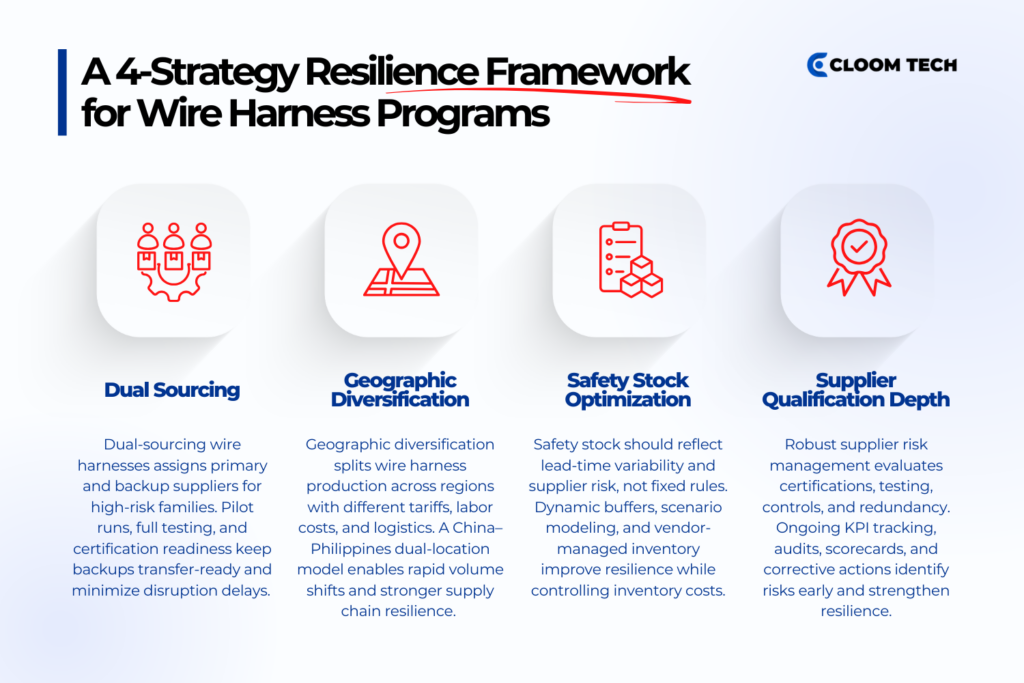
Mapping risk categories identifies where exposure exists. Acting on that map requires four concrete strategies that, together, reduce both the probability of disruption and its impact when one occurs.
Strategy 1: Dual Sourcing
Dual-sourcing wire harness programs start with a sourcing matrix for high-impact harness families. That matrix pairs a primary and secondary supplier or plant and defines volume share under normal and disrupted conditions. Working at the family level rather than part-by-part lets procurement teams prioritize the harness families with the highest line-down risk first.
The secondary source must stay warm through recurring pilot runs or overflow batches. Those batches must include the full test regime:
- 100% continuity verification
- Hi-Pot dielectric withstand testing
- Crimp pull-force verification
- Functional and connector retention checks
Keeping fixtures, test programs, and operator skills production-ready at both sources removes the reactivation delay that makes emergency transfers costly. Dual-sourcing programs that pre-screen suppliers for certification readiness before initiating qualification also avoids the process-improvement delays that otherwise compress transfer timelines.
Strategy 2: Geographic Diversification
Geographic diversification as a supply chain resilience strategy means splitting production across at least two regions with different tariff profiles, labor cost structures, and logistics routes. When combined with a dual-sourcing matrix, volume can be reallocated quickly when geopolitical, tariff, or transportation risks increase in one region.
Key considerations when selecting a diversification pairing:
- Tariff classification and origin rules for the target end markets
- Labor cost differential and expected wage trajectory
- Port infrastructure and sailing frequency to end markets
- Certification and regulatory alignment with program requirements
- Capacity and capability for the specific harness families involved
Cloom Tech’s China and Philippines dual-location model offers a useful practical illustration. OEMs gain access to established high-volume wire harness production capacity through the China facility, with a second manufacturing site in the Philippines providing lower tariff exposure and independent logistics routes. OEMs supplying North American or European markets benefit from a model spanning two distinct trade zones—single-geography sourcing cannot replicate that level of supply chain resilience.
Strategy 3: Safety Stock Optimization
Safety stock for wire harness programs is a resilience tool, not just a cost line item. Quantities must reflect actual lead-time variance and supplier risk score rather than be set arbitrarily across the program. One-size-fits-all policies fail because they ignore the different risk profiles across a harnessed, approved vendor list.
Forecast-driven stocking and scenario modeling should calibrate buffer levels to:
- Best-case and worst-case disruption windows by supplier and route
- ERP-tracked lead-time variance at the part family level
- Time-to-recover estimates for the high-risk node in each route
- Minimum coverage required to absorb a force majeure activation period
Supply chain resilience built on dynamic safety stock policies reduces carrying cost while maintaining coverage that static policies cannot provide. Vendor-managed inventory or local warehousing for high-risk harness families can extend that buffer effectively while keeping finished stock off the OEM’s balance sheet entirely.
Strategy 4: Supplier Qualification Depth
Supplier risk management that goes beyond basic certificate checks produces more durable supply chain resilience. Structured evaluations should cover:
- Certifications – ISO 9001, IATF 16949, and ISO 13485 as applicable; automation level and production line redundancy; incoming inspection procedures and approved vendor list controls
- Test coverage – continuity, Hi-Pot, pull-force, functional and environmental testing; calibration records for all crimp and test equipment; change control processes requiring notification before material substitution
Ongoing performance tracking connects qualification decisions about production reality. Track these KPIs on a defined cadence:
- On-time delivery rate (typical target: 95% or above)
- First-pass yield (typical target: 97% or above for mature production)
- Parts-per-million defect rate (typical target: under 500 PPM)
- Lead-time variance against rolling average
Pair those metrics with periodic audits, sourcing scorecards, and 8D or A3 corrective action processes. Emerging risk trends surface before they affect production when the monitoring system is active rather than reactive.
Country-Pair Comparison: Where Each Combination Wins
OEMs evaluating geographic diversification for their wire harness supply chain typically assess four country-pair models. Each carries distinct trade-offs.
| Country Pair | Key Considerations |
|---|---|
| China + Philippines | Lower tariff exposure on China-origin assemblies when Section 301 rates rise. Compatible time zones support unified program management. Growing wire harness and cable assembly manufacturing base. Lower labor cost than China, with improving infrastructure. |
| China + Mexico | Shortest transit time and logistics complexity for North American markets. Access to USMCA trade agreement benefits. Labor and facility costs exceed Southeast Asian alternatives at high volumes. Strong for programs where proximity to North American assembly plants is a priority. |
| China + Vietnam | Competitive labor rates and a rapidly growing electronics manufacturing base. Upward wage pressure as industrial zones reach higher utilization. Port and infrastructure constraints can limit throughput for high-volume programs. Effective for programs that need a second, low-cost Asian origin. |
| China + India | Long-term labor-cost advantages and a large available workforce. Harness-specific capability and infrastructure vary significantly by state and cluster. Higher due diligence is required during supplier selection. Strong for programs with long planning horizons and a tolerance for qualification investment. |
Case Study: Cloom Tech’s China + Philippines Dual-Location Model
Cloom Tech operates established harness and cable assembly capacity in China, serving global OEMs across automotive, industrial, medical, and telecommunications sectors. Key program facts:
- Quality systems include ISO 9001, IATF 16949, and IPC/WHMA-A-620 certified processes
- All production runs strictly from customer-provided drawings and specifications
- Component sourcing from global partners including Molex, JST, TE Connectivity, Amphenol, and Yazaki
- Prototype turnaround typically ~2 weeks
- Mass production delivery typically ~4–5 weeks
The dual-location model adds a second manufacturing site in the Philippines. OEMs can split programs between the China hub and the Philippines facility, reducing tariff exposure and labor-cost sensitivity for selected harness families. Both locations operate under the same quality management approach, and OEMs work through a single program management interface.
For procurement teams managing wire harness supply chain risk across multiple harness families, the dual-location structure provides:
- A lower-tariff origin for assemblies subject to Section 301 exposure
- Independent logistics routes to North American and European end markets
- Capacity to absorb volume reallocation without re-qualification
Ready to evaluate a dual-location wire harness strategy for your program? Get a free quote from Cloom Tech and compare your China and Philippines sourcing options.
Supplier Qualification Requirements: IATF 16949, ISO 13485, and FDA QSR
Formal qualification frameworks establish the documentation baseline on which supply chain risk management programs depend. Each framework imposes specific obligations on harness suppliers’ records.
- IATF 16949 section 8.4 expects automotive OEMs to define criteria for selecting, monitoring, and developing external providers. Required documentation includes:
- Harness supplier performance history against defined KPIs
- Audit findings and corrective action records
- Evidence of ongoing monitoring, not just initial approval
- ISO 13485 section 7.4 and FDA QSR section 820.50 require purchasing controls and supplier evaluations that support traceability and regulatory compliance for medical devices. Required documentation includes:
- Documented supplier evaluation criteria and re-evaluation intervals
- Purchasing controls tied to device risk classification
- Traceability records linking materials to finished assemblies
For OEMs supplying both automotive and medical markets, those two frameworks create parallel qualification obligations for the same harness manufacturing partners. Procurement, regulatory affairs, and quality assurance teams can shorten audit cycles by standardizing:
- Request-for-quote fields and acceptance test matrices across programs
- KPI thresholds applied consistently to all suppliers
- Supplier record formats that satisfy both IATF 16949 and ISO 13485 simultaneously
Supplier risk management programs that treat documentation requirements as ongoing obligations – not one-time qualification events – catch compliance gaps before they become audit findings or shipment holds.
How to Build a Wire Harness Risk Register
A risk register converts the seven categories into a working document that procurement and quality teams can act on. Without a structured register, supply chain risk remains abstract until a disruption forces the conversation. A well-maintained register makes that conversation routine.
Step 1: Set Up the Register Structure
Start by listing every active harness supplier and every harness part family on your approved vendor list. For each entry, score likelihood and impact separately across all seven risk categories. Multiplying the two scores generates a risk priority number for each category.
The register should capture:
- Supplier name, location, and manufacturing site address
- Part families supplied and annual spend per family
- Single-source or dual-source status for each part family
- Certification status and next renewal date for each relevant standard
- Logistics route and average transit time with historical variance
- Tariff classification and applicable duty rate
- Last audit date and open corrective action items
- Current safety stock level against target
Step 2: Assign Data Ownership
Ownership of each data field matters as much as the data itself. Procurement owns sourcing, geographic, logistics, and tariff fields. Regulatory affairs and quality assurance own certification, traceability, and corrective action fields. Both teams review the combined register quarterly and update scores when supplier performance metrics or external conditions change.
Part families with a risk priority number above a defined threshold move to active mitigation. Those below the threshold remain under standard monitoring. The threshold itself should reflect the business’s tolerance for line-down risk across its highest-volume programs.
Step 3: Keep It Current
The register is a living document, not a one-time audit output. Update it when a supplier changes manufacturing sites, when a certification lapses, when a new tariff rate takes effect, or when a corrective action closes. Each update should be time-stamped and clearly attributed to the team member who made it.
Version control means previous snapshots are available when an audit requests evidence. Under IATF 16949 and ISO 13485 external provider controls, auditors regularly ask when a risk was identified and when the mitigation response began. Teams that treat the register as static quickly find it reflects conditions from 12 months ago—a register that lags reality by a quarter is operationally useless where risk moves fastest.
Step 4: Connect It to Governance
High-volume automotive and medical harness families face direct line-down consequences from a single month of supply disruption. A quarterly review cadence tied to the supplier performance review cycle keeps the register current without creating unnecessary overhead.
Linking the register to the sourcing governance policy gives every mitigation decision a clear, documented rationale—and directly satisfies both IATF 16949 and ISO 13485 audit requirements for external provider controls.
KPIs and Trigger Thresholds for Harness Supplier Performance
A supplier risk management program without defined trigger thresholds is a monitoring system with no response mechanism. Thresholds convert performance data into decisions. Each metric should carry a defined action, an owner, and a resolution timeline.
The 5 KPIs to Track
The following KPIs are standard for harness supplier performance monitoring. Specific threshold values should be calibrated to each program’s risk tolerance and the supplier’s production maturity.
- On-time delivery rate: measures shipments arriving on or before the confirmed delivery date. A sustained drop below program-defined targets signals either a capacity issue or a logistics routing issue. The first response is a formal supplier review; the second is a safety stock increase while the root cause is investigated.
- First-pass yield: the percentage of harness assemblies passing all acceptance tests on the first attempt without rework. Declining yields signal process drift, tool wear, or incoming material quality issues. A corrective action request with a defined root cause deadline is the standard response.
- Parts-per-million defect rate: tracks field and incoming defects per million units shipped. Rising PPM on a mature production lot warrants a production hold review and an 8D root cause process.
- Lead-time variance: measures the deviation between quoted lead time and the rolling average. High-variance signals indicate capacity instability or logistics unpredictability. Programs with volatile lead-time variance should carry higher safety stock for that supplier’s part families.
- Corrective action closure rate: tracks the percentage of open corrective actions closed within the agreed resolution window. Suppliers with low closure rates are accumulating unresolved risk, regardless of how their delivery and quality metrics look in a given month.
Escalation Logic
Review all five metrics monthly. Trigger escalation when two or more metrics deteriorate simultaneously. A single metric dip may be transient, but concurrent deterioration across multiple KPIs signals a systemic supplier risk that warrants dual-source activation review.
Governance Log
Document every escalation and the action taken in a supplier governance log. That log becomes the evidence base for sourcing decisions, audit responses, and re-qualification justifications. Programs demonstrating consistent metric monitoring and documented responses are better positioned during IATF 16949 external provider audits. Informal supplier reviews leave no audit trail and no evidence of proactive risk management.
The governance log feeds updated performance data into the risk register. Likelihood scores for the quality and logistics risk categories update each quarter based on actual supplier performance rather than initial qualification assumptions.
How to Score and Prioritize Your Harness Supplier Base
Not every supplier on a harness approved vendor list carries the same risk. Prioritizing mitigation investment requires a scoring approach that accounts for both the probability of a disruption and the production impact if one occurs.
The 4 Scoring Dimensions
Score each supplier across four dimensions:
- Concentration exposure: reflects how much of a line-down harness family’s volume sits with a single supplier. A supplier holding 100% of volume for a line-down harness family scores highest. A supplier holding 30% of volume for a lower-risk harness family scores lowest.
- Geographic risk: reflects the supplier’s location relative to active geopolitical, tariff, and logistics risks. A supplier in a single country with no pre-qualified alternate in a different origin scores highest. A supplier with a validated capacity in two trade zones scores lowest.
- Quality and compliance maturity: reflects certification status, audit history, corrective action closure rate, and test infrastructure. A supplier with current ISO 9001 and IATF 16949 certification, a clean audit record, and documented 100% continuity testing scores lowest. Lapsed certifications or open corrective actions score highest.
- Financial and operational stability: reflects signals of supplier financial health, capacity utilization, and workforce stability. Publicly available signals include payment terms requests, capacity constraint communications, and changes in lead-time commitments.
Priority Tiers
Assign a score of 1 through 5 across each dimension and sum the four scores to generate a supplier risk priority score out of 20.
- Scores of 14 or above warrant active mitigation: dual-source qualification, safety stock increase, or a structured supplier development program.
- Scores of 8–13 warrant standard monitoring with defined review intervals.
- Scores below 8 are a low priority for active intervention.
Run the scoring exercise annually and after any significant change to a supplier’s production situation, certification status, or geopolitical exposure. Supply chain resilience in wire harness procurement depends on knowing which suppliers carry the most concentrated risk before a disruption forces that question.
Sharing Results With Suppliers
Communicate scoring results to suppliers in the high-risk tier. Suppliers that understand their risk score are more likely to engage in joint mitigation work—sharing sub-supplier maps, providing earlier capacity signals, and accepting consignment inventory arrangements all reduce the OEM’s exposure.
Supplier risk management works best as a collaborative process rather than a purely internal exercise. The scoring framework provides an objective, documented basis for that conversation without the subjectivity that makes supplier risk discussions difficult to act on.
FAQs on Supply Chain Risk Management for Wire Harness OEMs
How should we handle engineering changes without introducing new supply chain risk?
Treat every harness ECN as both an engineering and a sourcing event. Require updated samples, tests, and RoHS/REACH documents for each revision. Log every change in the risk register so dual sources and safety stock levels reflect the updated program.
What role should UL or similar traceability programs play in our harness strategy?
Use UL-style traceability to prevent non-compliant cable from entering your harness supply chain. Connect each assembly back to verified wires and materials through labeling. Combine traceability programs with your approved vendor list controls, incoming inspections, and audit schedules for complete supply chain coverage.
How early in product development should we involve harness suppliers to reduce downstream risk?
Engage key harness suppliers before connector families and routing constraints are frozen. Request manufacturability reviews and early test plans during the development phase. This reduces redesign cycles, qualification time, and the risk of one-off part numbers that create future single-source exposure.
How do we balance cost-down initiatives with harness supply chain resilience?
Evaluate every cost-down against total cost, not only piece price. Include tariffs, logistics, quality, and documentation risk in the analysis. Any cost-down step that increases single-source concentration without a compensating mitigation measure should not proceed until that exposure is addressed.
Back to Top: Supply Chain Risk Management for Wire Harness OEMs: A 2026 Resilience Playbook
