

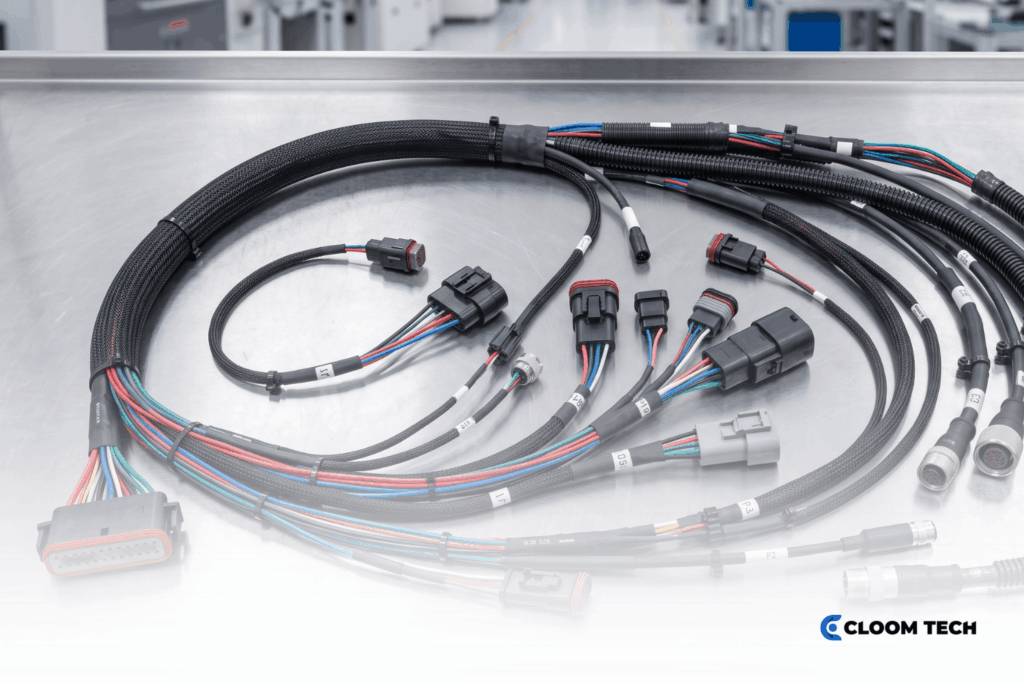
An automotive wire harness failure isn’t just a warranty event. In an OEM program, it can ground a production line or trigger a safety recall tracing back to one wire specification decision.
A layered set of standards governs automotive wire gauge selection. AWG is the baseline reference for North American engineers. International programs use metric mm² sizing under JIS and ISO.
Japanese supply chains follow JASO D611. North American connector specs route through USCAR-2 and USCAR-20. Temperature derating adds a variable that consumer-grade resources rarely address.
Getting any of them wrong produces a non-conforming harness that fails qualification, not a marginal product.
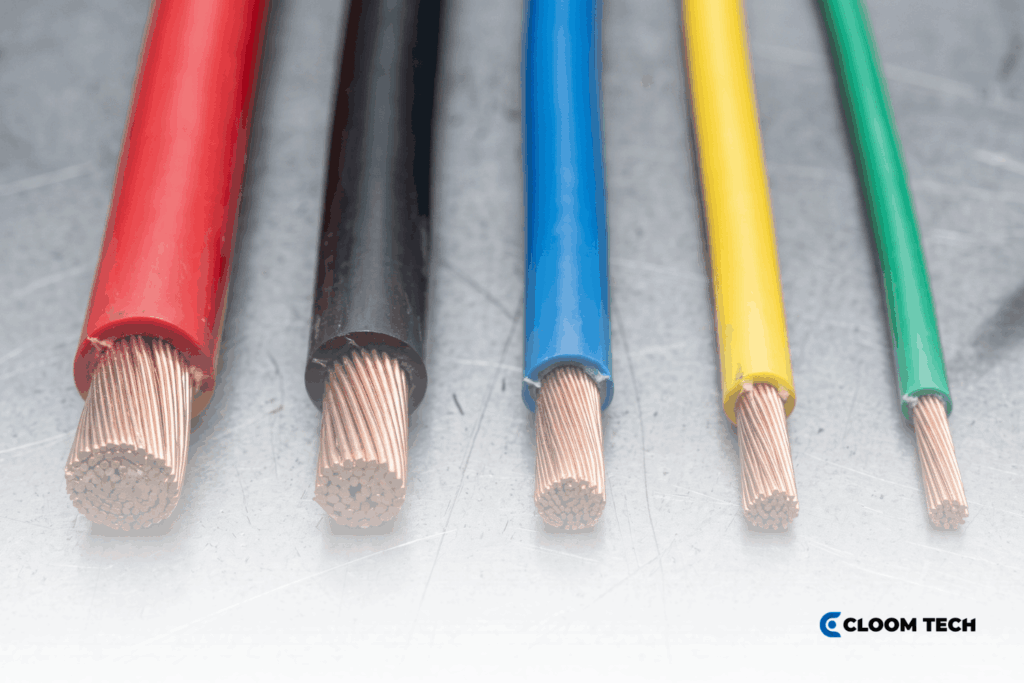
AWG vs. Metric Wire Sizing in Automotive
AWG (American Wire Gauge) and metric mm² are the two sizing systems used in global automotive programs. Confusing them during specification leads to errors that fail qualification.
AWG is the standard used in North American automotive programs and SAE J1128-compliant wire types. AWG uses an inverse scale (a lower number means a physically larger conductor). So 10 AWG carries significantly more current than 18 AWG. Engineers new to cross-regional programs often get tripped up by that inversion when reading Japanese or European drawings.
Metric sizing, expressed in mm², directly measures the conductor’s cross-sectional area. A larger mm² value means a larger conductor. International standards bodies (JIS, JASO, and ISO) all use metric sizing. Most European programs specify wire in mm² under ISO 6722 or DIN 72551. Japanese programs follow JASO D611 in mm² as well.
Conversion reference for common program gauges:
| AWG | Metric Equivalent (mm²) | Typically Used For |
|---|---|---|
| 20 | 0.5 | Signal wiring, sensors |
| 18 | 0.75 | Low-current control circuits |
| 16 | 1.0 | General body wiring |
| 14 | 2.0 | Lighting and moderate load circuits |
| 12 | 3.0 | Power feeds, motor circuits |
| 10 | 5.0 | Battery sub-circuits, high-current feeds |
| 8 | 8.0 | Main power distribution |
Automotive Wire Gauge (AWG) Chart
SAE J1128:2020 (Low-Voltage Primary Cable) defines the construction and performance requirements for automotive primary wire (conductor material, stranding, insulation type, and wall thickness). It is a construction specification, not an ampacity standard. Current-carrying capacity for automotive wiring falls under SAE J1292 (chassis wiring) and SAE J2183 (power wiring).
The ampacity values below come from permissible current tables for AVS conductors (JASO D609) and published references for SAE J1128-type cables. Chassis amps apply to single-conductor runs in open air (typical for accessory and control circuits).
Power amps apply to bundled wiring in hot, underhood environments with continuous load. Power ratings are lower because bundled conductors in a high-ambient environment cannot shed heat as effectively.
| AWG | Conductor Cross-Section (mm²) | Chassis Amps (Open Air) | Power Amps (Bundled/Underhood) | Typical Automotive Application |
|---|---|---|---|---|
| 20 | 0.5 | 11 | 8 | Sensor signals, low-current control |
| 18 | 0.75 | 16 | 12 | Body control modules, switches |
| 16 | 1.0 | 22 | 17 | Interior lighting, relay outputs |
| 14 | 2.0 | 32 | 24 | 14 gauge automotive wire (lighting harnesses, HVAC motors) |
| 12 | 3.0 | 41 | 31 | Power feeds, actuator circuits |
| 10 | 5.0 | 55 | 42 | High-current sub-circuits |
| 8 | 8.0 | 73 | 55 | Battery cables, main distribution |
A 12V automotive wire gauge chart uses the same AWG-to-current values above. Voltage drop (not ampacity) is the binding constraint in most 12V circuits. A 1V loss represents more than 8% of a 12V supply, compared to under 1% in a 120V building circuit. Programs typically allow a maximum 3% voltage drop on critical circuits such as ignition, fuel pumps, and ECUs. Non-critical accessories may tolerate up to 10%.
On runs exceeding 10 feet, calculate round-trip conductor length and size up. Ampacity alone will often allow a smaller gauge than voltage drop permits. All sizing examples above assume a 12V nominal system. Vehicles with 24V electrical architectures draw half the current for an equivalent power load. That allows roughly two AWG sizes smaller for the same run length.
Specify harnesses for 48V mild-hybrid subnets against the OEM’s dedicated documentation (fault-current and arc-fault requirements at 48V go beyond simple gauge scaling).
JASO D611 and Japanese Automotive Wire Standards
JASO (Japan Automotive Standards Organization) publishes D611 as the governing standard for low-voltage automotive wires used in passenger vehicles. Japanese OEM supply chains specify JASO wire types at the drawing level, so any harness manufacturer producing for those programs must understand the type designations.
JASO D611 covers four primary wire types, each defined by insulation wall thickness and temperature capability.
- AV: Standard-wall PVC insulation, rated to 80°C. General-purpose wiring in body harnesses where space is not constrained.
- AVS: Thin-wall PVC insulation, rated to 80°C. Lighter and smaller in diameter than AV, used where harness weight reduction matters.
- AVSS: Super-thin-wall PVC insulation, rated to 80°C. The most compact of the PVC-insulated JASO types, specified in high-density harness zones.
- AEX: Cross-linked polyethylene (XLPE) insulation, rated to 120°C. Specified in higher-temperature zones (engine compartment adjacencies, underbody routing near exhaust).
All four types use stranded bare copper conductors compliant with RoHS requirements. What differentiates them is insulation thickness and thermal class (two variables that directly affect harness routing decisions).
USCAR Standards for Connectors and Wire
USCAR (United States Council for Automotive Research) publishes performance standards that govern connector and terminal qualification in North American OEM programs. Two standards appear most frequently in wire harness specifications.
- USCAR-2: Performance requirements for automotive electrical connectors. This standard defines the test matrix connectors must pass (thermal cycling, vibration, humidity exposure, and mating force) to qualify for a vehicle program. When a North American OEM drawing references USCAR-2, the connector specified must carry documented test data against that standard before the harness ships.
- USCAR-20: Terminal performance requirements specifically. Terminals must meet defined criteria for contact resistance, retention force, and durability under repeated mating cycles. USCAR-20 compliance shapes wire harness assembly directly. Terminal crimp specifications must fall within the connector manufacturer’s validated crimp window (established during USCAR qualification testing).
The interaction with automotive wire gauge selection is direct. Terminal crimp barrels match specific conductor cross-sections. Specifying a wire gauge outside the validated range for a USCAR-qualified terminal invalidates the existing qualification data. OEMs may approve controlled deviations with additional testing, but the requalification burden is significant in a production program.
Temperature Ratings and Derating
Gauge alone does not determine whether a wire suits a given circuit. Temperature exposure at the installation location changes the wire’s ampacity, and selecting the wrong thermal class produces premature insulation degradation in service.
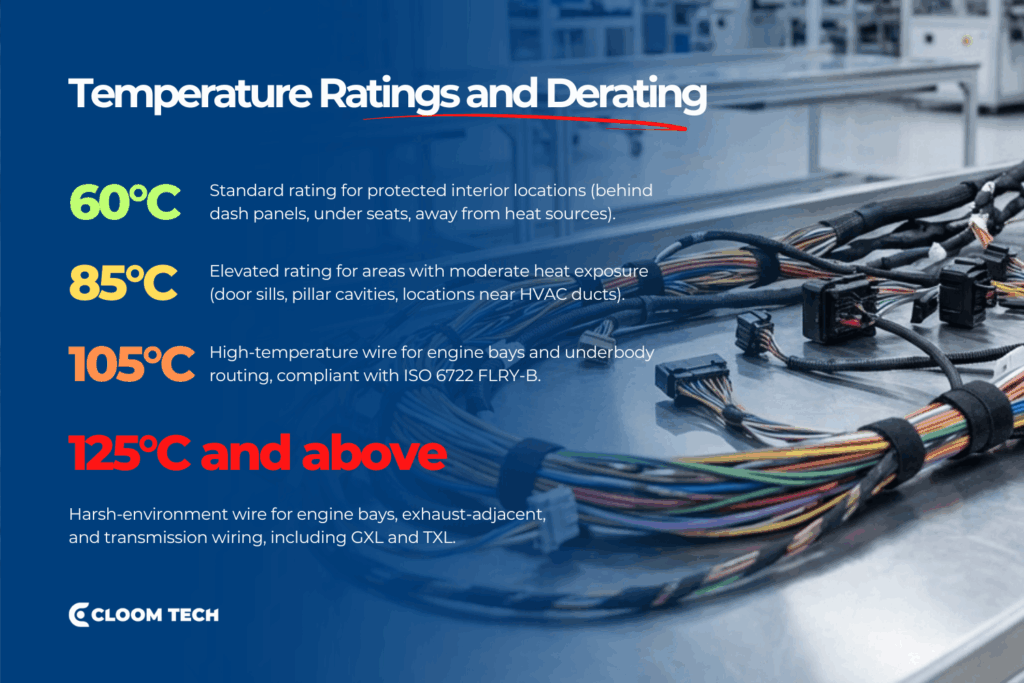
Programs segment temperature requirements into four bands. ISO 6722 formalizes cable temperature classes alongside these bands (Class C covers up to 125°C, and Class D up to 150°C).
- 60°C: Standard rating for protected interior locations (behind dash panels, under seats, away from heat sources).
- 85°C: Elevated rating for areas with moderate heat exposure (door sills, pillar cavities, and locations near HVAC ducts).
- 105°C: High-temperature rating for engine bay periphery and underbody routing away from direct exhaust proximity. FLRY-B under ISO 6722 targets this class.
- 125°C and above (ISO 6722 Class C): Harsh-environment rating for direct engine bay routing, exhaust-adjacent harness segments, and transmission area wiring. GXL and TXL under SAE J1128 fall into this band, with AEX under JASO D611 (rated to 120°C) sitting just below.
| Application Location | Typical Temperature Exposure | Recommended Wire Rating |
|---|---|---|
| Interior cabin, protected | Up to 60°C | 60°C standard |
| Door, pillar, moderate heat zone | Up to 85°C | 85°C elevated |
| Engine bay periphery, underbody | Up to 105°C | 105°C high-temperature |
| Exhaust-adjacent, transmission | 125°C and above | ISO 6722 Class C / 125°C+ |
Where ambient temperature at the installation point exceeds the base test condition, adjust the figures in the automotive wire gauge chart downward. Per commonly published ampacity and bundling guidance for automotive conductors, engine bay general routing reduces allowable current by approximately 20%.
Exhaust- or turbocharger-adjacent routing requires a 30% reduction or a step up in thermal class. Bundled runs of four to six conductors carry a 20% adjustment from open-air chassis ratings; bundles of seven or more require 30%.
Work With an IATF 16949-Certified Wire Harness Manufacturer
Cloom Tech manufactures custom wire harnesses for OEM automotive programs under IATF 16949 certification. As a build-to-print contract manufacturer, our team works strictly from your approved drawings and specifications. While we do not offer ground-up product engineering, we provide comprehensive DFM (Design for Manufacturability) reviews of pre-existing drawings to flag specification issues before production begins.
We support automotive-grade wire selection, PPAP documentation, and volume production for programs across Asia, Europe, and the Americas.
Need a wire harness built to your OEM automotive spec? Get a free quote from Cloom Tech.
OEM Automotive Wire Harness Standards FAQs
What wire gauge is standard for automotive?
Most body wiring in North American OEM programs runs between 18 AWG and 14 AWG, covering the majority of signal and moderate-load circuits. Programs built to JASO or ISO specifications often use metric conductors at 0.35 mm² or 0.5 mm² for signal lines (below the typical AWG range). The exact gauge depends on current draw, circuit length, thermal class, and whether the program references SAE, JASO, or ISO standards.
What is the difference between AWG and mm² for automotive wire?
AWG is an inverse scale used in North American programs (smaller numbers mean larger conductors). Metric mm² measures conductor cross-sectional area directly, with larger values indicating larger conductors. ISO 6722 also defines conductor classes and strand counts beyond the cross-sectional area. Two conductors at the same nominal mm² may differ in stranding and flexibility depending on the class specified. JASO and ISO standards use mm², while SAE J1128 uses AWG.
What does USCAR-2 mean for automotive wire harnesses?
USCAR-2 specifies the qualification test requirements for electrical connectors used in North American OEM programs. A connector referenced on an OEM drawing must carry documented USCAR-2 test data (thermal cycling, vibration, humidity) before entering production. Many OEM drawings reference additional USCAR documents governing system-level behavior. A single harness program may need to satisfy USCAR-2, USCAR-20, and other specifications simultaneously.
How does temperature affect automotive wire gauge selection?
Higher ambient temperature at the installation location reduces a conductor’s ampacity. A wire rated for 32A in open air at room temperature may only safely carry 24A in a bundled, underhood environment (roughly a 25% reduction). In exhaust-adjacent routing, that figure reaches 30%, which may push the specification to a larger gauge or a higher thermal class entirely. Ignoring location-based derating is one of the most common specification errors in harness programs that cross from interior to underhood routing.
Back to Top : OEM Automotive Wire Harness Standards: AWG, JASO, and USCAR for Engineers
