


Most U.S. wire harness imports fall under HTS code 8544, and the correct subheading determines both duty exposure and CBP risk. Vehicle wiring sets are classified under 8544.30, while non-vehicle connectorized assemblies use 8544.42.
China-origin 8544.30 harnesses face a 5% base duty plus a 25% Section 301 surcharge, reaching roughly 30% effective duty. For 8544.42.20.00, the rate is 2.6% base plus 25% Section 301, landing at approximately 27.6%.
Assigning the accurate wiring harness HTS code supports landed-cost calculations and confirms origin compliance. Importers must verify the final HTS code, country of origin, and duty rates with a licensed customs broker before filing.
What HTS Code Covers Wire Harnesses?
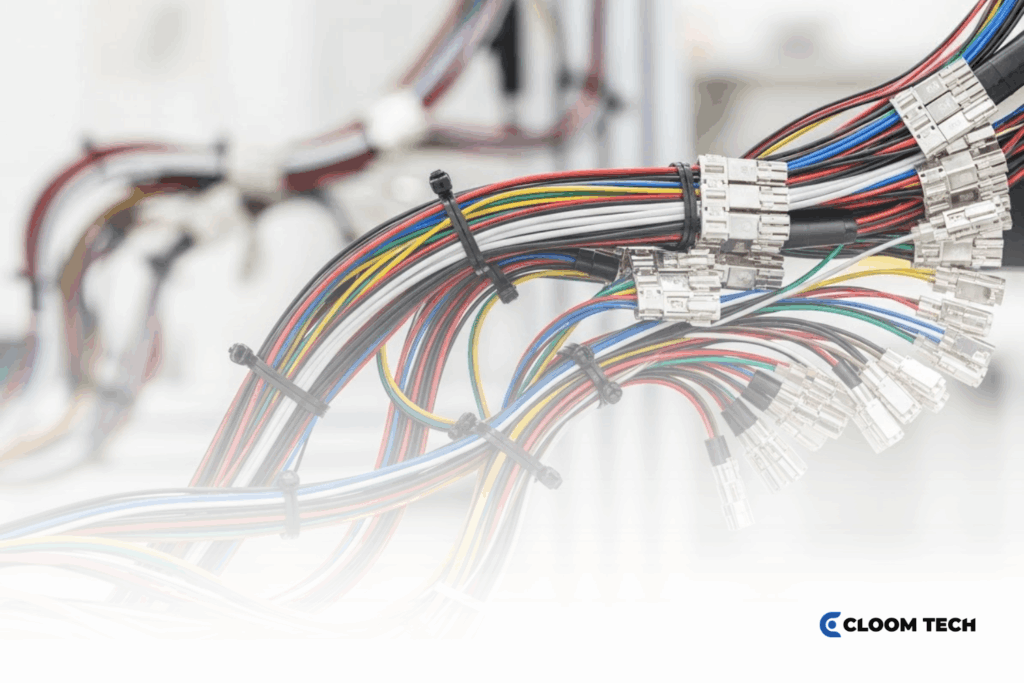
Wire harnesses fall under HTS code 8544, the schedule’s home for insulated wire and cable. The exact subheading depends on application and connector configuration—and that choice sets the duty rate you pay at entry.
HS / HTS Structure in One Minute
The Harmonized System (HS) assigns every traded product a 6-digit code shared across over 200 countries. The United States extends each code to 10 digits, and the full HTS line sets the duty rate. The first six digits stay constant worldwide; the last four are U.S. statistical details that pinpoint your exact rate.
Heading 8544 covers insulated wire, cable, and other conductors, whether or not connectors are fitted. Wire harnesses are classified under Chapter 85, Heading 8544, alongside building wire and fiber-optic cable.
The Two Primary Wire Harness Codes
Two subheadings capture most harness imports. HTS 8544.30.0000 covers ignition wiring sets and other wiring sets for use in vehicles, aircraft, or ships—automotive and aircraft harnesses land here.
HTS 8544.42 covers other electric conductors fitted with connectors for a voltage not exceeding 1,000 V. Industrial, medical, and electronics assemblies fit this code when they carry connectors but serve non-vehicle equipment.
Most harnesses fall into one of these two buckets. The split turns on end-use application, not physical construction, which the next section breaks down.
HTS 8544.30 vs. 8544.42: Which Applies to Your Wire Harness?
Whether your harness classifies under HTS code 8544.42 or 8544.30 depends on end use, not build. Vehicle wiring sets fall under 8544.30, while non-vehicle connectorized assemblies fall under 8544.42, and that distinction drives your duty rate.
Application, Not Construction, Drives the Split
Two physically identical harnesses can carry different codes—CBP classifies based on the declared end use, not how the assembly is built. The same bundle of wires and connectors shifts subheading when the destination application changes.
A harness built for vehicle, aircraft, or ship wiring belongs in 8544.30, and OEM automotive harnesses are the textbook case. When the assembly instead serves industrial, medical, or electronics equipment, the wiring harness HTS code moves to 8544.42. Cable assemblies feeding control panels, devices, or machinery fit there, provided they carry connectors and stay under the voltage threshold.
Five-Step Classification Sequence for Wire Harnesses
Run the sequence in order and stop at the first code that fits. The five steps move from the broadest test down to the connector check that splits the final two codes.
- Step 1: The product consists of insulated electric conductors, placing it in Chapter 85, Heading 8544.
- Step 2: If the assembly transforms signals—such as a protocol converter or a multi-format adapter—reclassify under 8517.62 or 8471.80 and exit 8544.
- Step 3: A harness built as vehicle, aircraft, or ship wiring goes to 8544.30.
- Step 4: Measure non-vehicle harnesses against the 1,000 V line.
- Step 5: At or under 1,000 V with connectors, use 8544.42. Without connectors, use 8544.49.
What “Fitted With Connectors” Really Means
The term covers far more than a plug at the cable end. Any termination that joins a conductor to a contact point qualifies:
- Crimped terminals
- Soldered pins
- IDC headers
- Molded plugs
- Ferrules
- Board-level headers
A harness with one terminated end and one bare end still counts as fitted with connectors, because the single termination meets the standard. Importers err here by classifying terminated cable under 8544.49—the subheading reserved for unterminated conductors. Inspect both ends before you classify. One crimped terminal pulls the assembly into 8544.42 and changes the rate you owe at entry.
Common Misclassification Traps
Most penalty exposure traces back to four recurring errors, each pushing a harness into the wrong subheading and changing the duty owed at entry. The cost multiplies when the same coding logic repeats across a program.
- Vehicle code on non-vehicle harnesses – applying 8544.30 to industrial harnesses that sit inside a vehicle when the code requires the harness to be designed as vehicle wiring.
- Terminated cable under the wrong line—classifying terminated harnesses under 8544.49, the subheading reserved for unterminated conductors.
- Signal-processing assemblies left in 8544 – keeping protocol converters and similar devices in 8544 rather than moving them to 8517.62 or 8471.80.
- Overpayment or underpayment exposure – each error inflates duty or underpays it, and underpayment invites CBP penalties.
Section 301 Tariff Exposure on China-Origin Wire Harnesses
China-origin wire harnesses carry a Section 301 surcharge stacked on top of the base duty. The combined figure pushes effective rates far above the headline MFN number for Heading 8544 – often past 28% on common automotive and connector codes.
Base MFN Duty vs. Section 301 Add-Ons
The base Most Favored Nation (MFN) duty for products in Heading 8544 runs from roughly 0% to 5%, depending on the subheading and cable construction. Section 301 changes the math entirely for China-origin goods—it is an extra percentage, not a replacement, so a harness with a 5% base duty pays both layers at entry.
Other charges can stack on top as well. A temporary 10% Section 122 surcharge on imports from all countries is in effect through July 24, 2026, unless extended. Confirm the full stack with your customs broker, as the effective rate can exceed the figures shown here.
Code-by-Code Example Rates
The effective rate depends entirely on the subheading. The table below shows how base duty and Section 301 combine for four common China-origin codes. Confirm every figure against current HTS and USTR sources before budgeting against it.
| HTS Code | Description | Base MFN Duty | Effective Rate (China-Origin) |
|---|---|---|---|
| 8544.30.00.00 | Vehicle wiring sets | 5% | ~30% (+ Section 301) |
| 8544.42.20.00 | Copper conductors ≤1 kV, with connectors | 2.6% | ~27.6% (+ Section 301) |
| 8544.42.90.90 | Other ≤1 kV conductors, with connectors | 3.5% | ~28.5% (+ Section 301) |
| 8544.49.90.00 | Other ≤1 kV conductors, no connectors | 3.5% | ~28.5% (+ Section 301) |
Exclusions and Why They’re a Moving Target
USTR grants product exclusions that temporarily remove the Section 301 layer from narrowly described goods, dropping a China-origin harness back to its base duty alone. As of January 2026, approximately 178 exclusions were active, though the list turns over as grants expire and new ones are issued.
Exclusions are written against specific product descriptions, carry hard expiration dates, and get extended, narrowed, or dropped without much warning. The current round is set to expire on November 10, 2026, unless extended. Match your product to the exact exclusion wording, and confirm its current status with a customs broker or trade counsel before classifying around it.
Penalty and Enforcement Exposure
Getting classification wrong on a China-origin harness exposes you to more than back duty. CBP scales its penalties to your level of fault, and the operational fallout often costs more than the dollar figure on the notice.
- Penalty tiers: misclassification falls into negligent, grossly negligent, or fraudulent conduct under the customs statute, with maximum penalties rising sharply at each tier.
- Typical exposure: negligent cases commonly settle at $5,000–$10,000 per entry, plus re-liquidation and back-duty on the underpaid amount.
- Operational impact: expect 2–4 week clearance delays, higher inspection rates on the flagged shipment, and added scrutiny on future entries.
How to Calculate Landed Cost for Wire Harnesses From China
The landed cost is the full price of a China-origin harness at your dock, not the supplier’s quote. It bundles the customs value, the HTS code 8544 base duty, the Section 301 surcharge, and all fees into a single budget number.
Step-by-Step Landed Cost Formula
The formula moves in order, since each figure builds on the one before it.
- Step 1: Determine the customs value behind your wiring harness HTS code. It includes the transaction price plus freight, insurance, and any assists such as tooling or molds.
- Step 2: Apply the base HTS duty rate to that customs value.
- Step 3: Apply the Section 301 percentage to the same customs value for China-origin harnesses.
- Step 4: Add remaining import charges to reach full landed cost—including Merchandise Processing Fee (MPF), Harbor Maintenance Fee (HMF) where applicable, brokerage, and domestic freight.
Worked Example: Automotive Harnesses From China
Take a $50,000 shipment of automotive harnesses classified under 8544.30.0000. The 5% base duty adds $2,500, and the 25% Section 301 surcharge adds another $12,500 against the same customs value. Together, they reach a 30% effective rate and $15,000 in combined duty before any processing fees or freight.
That ratio holds as volume grows. The same harness program at $600,000 per year carries $180,000 in annual duty. The percentage looks modest on its own. Across a full program, it becomes one of the largest controllable line items in your sourcing budget.
Annual Governance and Review
Duty exposure shifts as rates, exclusions, and sourcing decisions change, so landed cost is a number you manage rather than set once. A standing review keeps your budgets and classifications aligned with current rules.
- Track annual duty spent by HTS code and country of origin, separating high-rate lines like HTS code 8544.42 from the rest.
- Review Section 301 rates, active exclusions, and sourcing assumptions at least once a year, or sooner after a major USTR change.
- Reassess whenever a new supplier, a changed build location, or a new product family is introduced.
Sourcing from a certified manufacturer with documented origin processes reduces both duty exposure and CBP verification risk. Learn how Cloom Tech’s custom wire harness programs support your classification and origin requirements.
Country of Origin Rules for Wire Harnesses
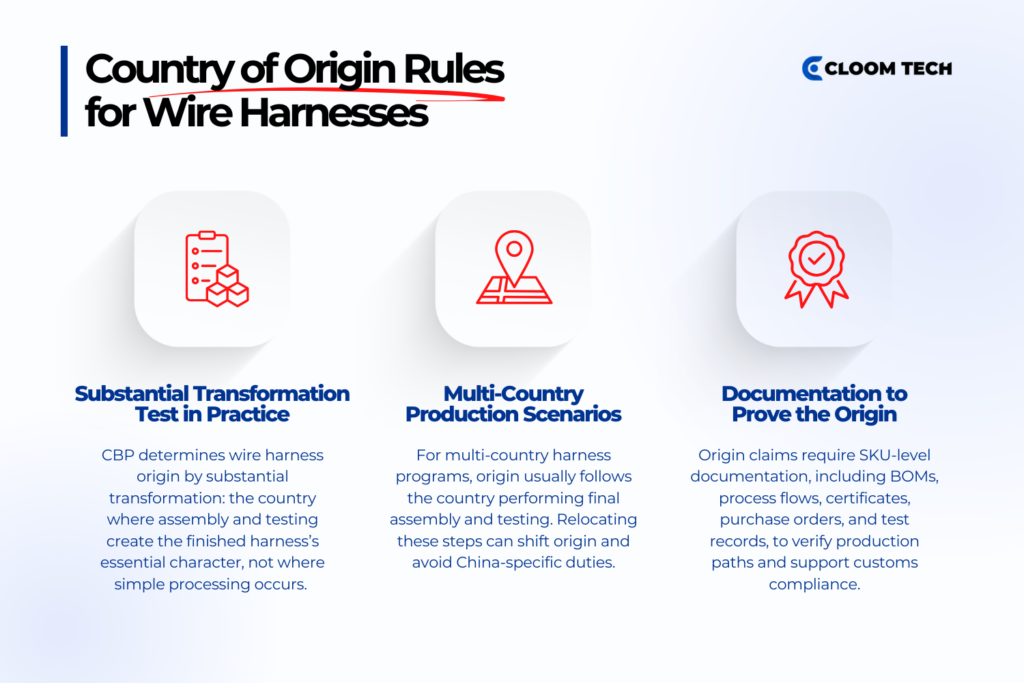
The country of origin determines which duty rate applies and whether Section 301 applies to your shipment. For wire harnesses, origin follows where the harness becomes a finished, functional assembly—not where the raw materials start.
Substantial Transformation Test in Practice
CBP applies the substantial transformation test to determine origin, which turns on where the product acquires its essential character. The rule looks past raw inputs to the operation that creates the finished harness.
- Origin is the country where the harness undergoes a fundamental change in name, character, or use.
- Cutting wire, stripping insulation, and similar simple operations alone typically do not qualify.
- Connector termination combined with assembly and testing usually does, since loose conductors are combined into a specific harness for a defined application.
Multi-Country Production Scenarios
Most harness programs span more than one country, so the origin rarely coincides with where the wire started. The last country to perform full assembly and testing usually retains the origin, even when upstream work is done elsewhere.
- In a split setup – wire drawing in one country, cutting and stripping in China, final crimping and assembly in a third – the country doing full assembly and testing typically becomes the origin.
- Moving final crimping, assembly, and testing out of China can shift origin away from China, even when some upstream wirework remains there.
- The origin shift removes China-specific Section 301 duties while the harness retains its 8544.30 or 8544.42 classification.
Documentation to Prove the Origin
Origin holds up only as far as your records support it. Build the proof file by SKU so any harness ties back to a documented production path.
- Maintain bills of materials showing the source of each wire, connector, and major component.
- Keep process flows and routing sheets that map which operations occur in which country.
- File wire mill certificates, connector purchase orders, production travelers, and IPC-620 test reports by SKU.
- Clear, indexed origin records speed CBP verifications and cut the risk of disputes over where transformation occurred.
Philippines Origin as a Section 301 Alternative
Moving final assembly to the Philippines can change a harness’s country of origin and remove the China-specific Section 301 surcharge. The HTS code stays the same, so the base duty holds while the 25% China surcharge falls away.
Same HTS Classification, Different Origin
Classification follows the product, not the country. As long as the harness and its end use stay constant, it keeps the same HTS code—vehicle sets use 8544.30 and connector assemblies use 8544.42.
- Section 301 is origin-based, so a Philippines-origin harness sits entirely outside the China-specific surcharge.
- The base HTS duty rate remains unchanged, as the product description and classification are the same.
- Final crimping, assembly, and testing outside China often shifts origin through substantial transformation—confirm the threshold with your customs broker before relying on this approach.
Before and After Duty Comparison
The origin change shows up directly in the effective rate. The table below uses a representative harness program to make the difference concrete.
| China Origin | Philippines Origin | |
|---|---|---|
| HTS code | 8544.30 or 8544.42 (unchanged) | 8544.30 or 8544.42 (unchanged) |
| Base MFN duty | Applies | Applies |
| Section 301 | 25% surcharge applies | Not applicable |
| Effective rate (8544.30 example) | ~30% | ~5% (base duty only) |
Note: Figures are illustrative examples only. Confirm current rates, exclusion status, and origin thresholds with a licensed customs broker before making sourcing or classification decisions.
Cloom Tech’s dual-location model—with facilities in China and the Philippines—gives OEMs a practical path to compare sourcing scenarios and reduce Section 301 exposure. Get a free quote and discuss your program’s origin and tariff options with our team.
CBP Documentation Checklist for Importing Wire Harnesses
Clean paperwork ensures correct codes and origin decisions result in smooth CBP clearance. The classification and origin call set your duty rate—the documents are what prove the entry and clear it without a hold.
Entry Documents
Every entry requires a standard set of filings that allow CBP to match the goods to the declared classification.
- Commercial invoice listing product descriptions, HTS codes, origin, unit values, and currency.
- Packing list that matches the invoice line for line.
- Bill of lading or air waybill covering the shipment.
- Certificate of origin, where relevant, especially for non-China origin or FTA claims.
- Import Declaration Form (IDF) when required by the destination country.
- Any required security filings are submitted through your broker.
Origin and Substantial Transformation Support File
The support file is your proof when CBP asks you to substantiate the origin and transformation. The entry documents declare the origin, but the file behind them survives a verification request.
- Bills of materials showing the source of each material.
- Process flows and routing sheets that show where each operation occurs.
- Wire mill certificates and connector purchase orders.
- Production travelers and test reports (such as IPC-620) are tied to specific SKUs.
Keep the file indexed by SKU so each shipment can be substantiated on demand.
When to Seek a Binding Ruling
A binding ruling locks CBP into your classification and earns its place on high-value or ambiguous entries.
- When: high annual value, ambiguous classification between 8544.30, 8544.42, 8517, or 8471, or new product families that need consistency.
- How: File through the CBP electronic ruling portal with photos, drawings, BOM, connector specs, voltage, end use, manufacturing steps, and your proposed HTS. Expect a 30–90 day turnaround.
- Why: CBP is then bound to that classification for as long as the facts stay the same.
On a single small entry, the 30–90 day wait rarely pays off. On a recurring program where one classification repeats across thousands of units, the certainty usually outweighs the delay.
FAQs on Wire Harness HTS Code 8544.30
What is the correct HTS code for an automotive wire harness with connectors?
A connectorized automotive harness still classifies under 8544.30, but the 10-digit line depends on conductor material and voltage. Pull the exact statistical suffix from the current HTS schedule, as the duty rate lives in those last four digits.
How do I decide between 8544.30 and 8544.42 for a mixed-use harness?
Classify the whole run by its principal use – the application that accounts for the largest share of units. Document how you determined that share, because CBP can challenge a principal-use call that isn’t supported by your own production records.
What duty rate should I budget for China-origin automotive harnesses today?
Build the budget around the effective rate, then add a contingency for rate volatility. Section 301 percentages and exclusion eligibility can change between the order and the entry, so lock the rate to the entry date, not the quote date.
How does moving the final assembly to the Philippines change my tariff exposure?
The savings are real only if the upstream Chinese content doesn’t survive as the essential character of the finished assembly. If China still supplies a near-complete subassembly and the Philippines only adds a final connector, CBP may rule that the origin never shifted. Stage enough of the build in the Philippines to clear the substantial transformation test, and confirm the threshold with your customs broker.
What happens if CBP disagrees with my classification or origin claim?
CBP can re-liquidate, collect back-duty, and assess penalties scaled to fault, reaching back up to five years on prior entries. Exposure compounds across every entry that uses the same wrong code, which is why one bad classification on a repeat program gets expensive fast.
How often should I review my HTS and Section 301 assumptions?
Review them at least once a year as a baseline. A new supplier, a changed build location, a fresh USTR action, or a new product family each warrants an off-cycle check.
Back to Top: Wire Harness HTS Code 8544.30: Importer’s Guide to Tariffs, Documentation and Sourcing
