

Engineers mix up UL Listed equipment, UL Recognized components, and UL 508A panel requirements more often than you’d expect. The result is failed inspections and costly retrofit work during commissioning.
The three terms aren’t interchangeable. A UL Listed mark covers a finished, installation-ready unit, while a Recognized component only operates inside a protected assembly or industrial control panel. Mix them up at the procurement stage and you can end up specifying the wrong power supply or paying for certification work you never needed.
This guide breaks down what each classification means, when to use it, and how the three fit together so you can specify compliant hardware with confidence.
What is UL 508A?
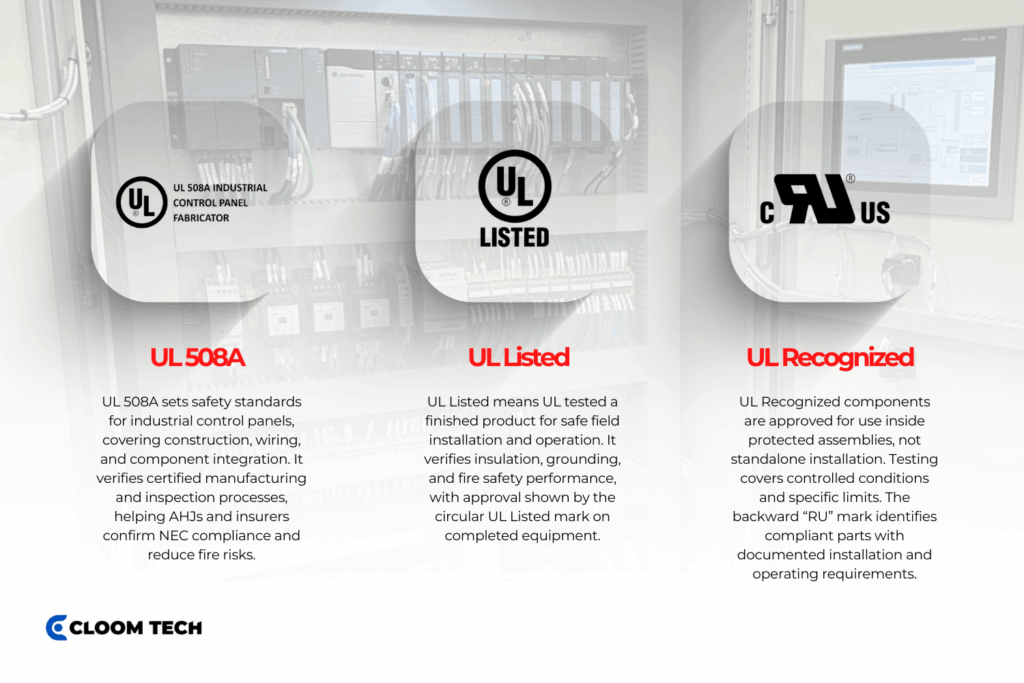
UL 508A is the safety standard for industrial control panels. It covers how a panel is built, including the construction practices, wiring methods, and electrical assemblies inside the enclosure.
The standard pays close attention to wiring and component integration because uncontrolled fault current can cause fires or damage equipment. It doesn’t rubber-stamp every panel, either. UL 508A verifies documented manufacturing procedures and inspection practices inside certified production facilities.
That paper trail matters in the field. Authorities Having Jurisdiction (AHJs) and insurers often review UL certification records and the applied UL mark when they check a panel for National Electrical Code (NEC) compliance.
What does UL Listed Mean?
UL Listed means UL has evaluated a finished product for direct installation and normal field use. The whole unit gets tested under defined operating conditions, not just a single component.
Inspectors check things like insulation integrity and grounding performance, since electrical faults or moisture can create fire hazards once the equipment is installed. You’ll recognize the approval by the circular UL mark containing the word “Listed.” It appears on standalone equipment such as motors, heaters, appliances, and fully assembled panels.
What does UL Recognized Mean?
A UL Recognized component is approved for use inside a protected assembly, not for direct installation as standalone equipment. The testing is narrower and focuses only on controlled operating conditions, because the part is meant to function within specific electrical limits set during evaluation.
Look for the backward “RU” symbol. It identifies recognized products such as relays, circuit boards, terminal blocks, and power supplies that get built into a larger system.
Every Recognized component also comes with documented Conditions of Acceptability – voltage ratings, spacing requirements, approved enclosure types, and mounting limits. Ignore those restrictions and you can void the component’s recognized status during inspection or field review.
Common Misconceptions and Risks
Loose UL terminology causes real compliance headaches, and the confusion between Listed and Recognized usually surfaces at the worst possible time – during inspection or commissioning. A few patterns show up again and again:
- Marketing phrases like “UL certified” or “UL approved” mislead buyers, because they don’t spell out the actual UL status or the scope of the evaluation.
- Some teams install UL Recognized power supplies as exposed equipment, even though many recognized products only qualify for protected, integrated conditions.
- UL Classified is a separate category again. It applies to products tested against narrow hazards or very specific operating environments.
- Get the classification wrong and the costs stack up fast: failed inspections, forced replacements, delayed startups, and expensive re-certification.
Practical Decision Framework for Engineers and Buyers
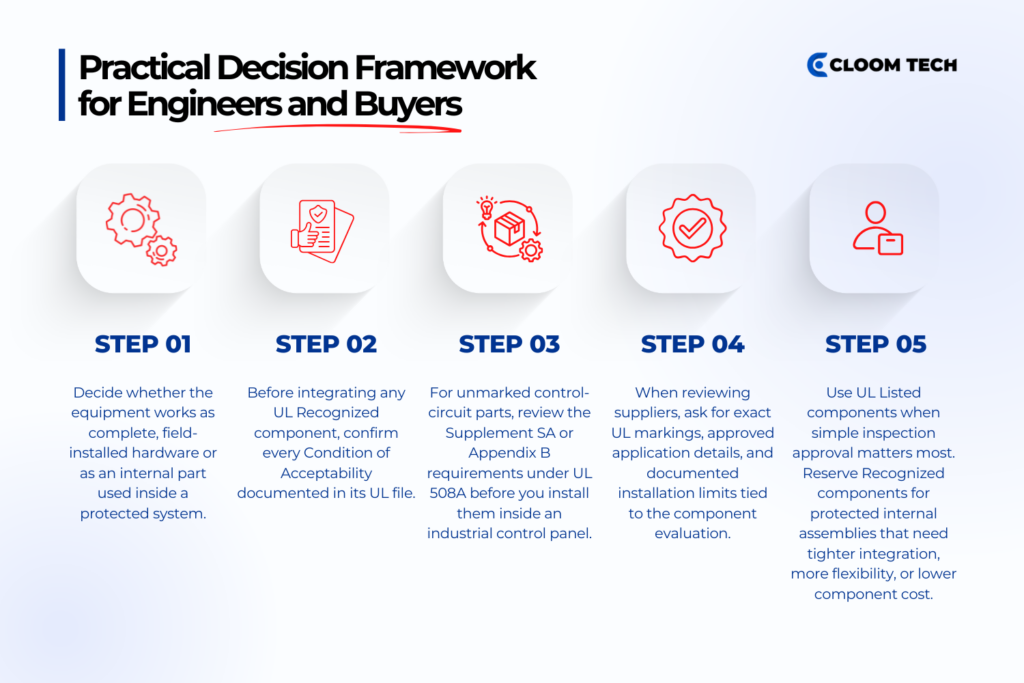
Choosing the right classification early cuts inspection delays and prevents expensive redesign during panel approval. Verifying certification scope and installation requirements up front also helps you avoid sourcing conflicts before fabrication starts.
- Step 1: Decide whether the equipment works as complete, field-installed hardware or as an internal part used inside a protected system.
- Step 2: Before integrating any UL Recognized component, confirm every Condition of Acceptability documented in its UL file.
- Step 3: For unmarked control-circuit parts, review the Supplement SA or Appendix B requirements under UL 508A before you install them inside an industrial control panel.
- Step 4: When reviewing suppliers, ask for exact UL markings, approved application details, and documented installation limits tied to the component evaluation.
- Step 5: Use UL Listed components when simple inspection approval matters most. Reserve Recognized components for protected internal assemblies that need tighter integration, more flexibility, or lower component cost.
How to Verify Genuine UL Markings
Counterfeit or misleading UL markings can sink a project at inspection. A quick verification step confirms a component is genuine before it ever reaches production or the field.
- Find the UL file number on the product label, packaging, or datasheet. Many genuine labels show an “E” prefix followed by several digits.
- Search that file number in UL Product iQ to confirm the manufacturer, the applicable UL standard, and the approved product category.
- Check the product’s approved installation purpose in the same Product iQ record before you commit to procurement.
- Inspect the physical label closely. Missing control numbers, poor print quality, odd spacing inside the UL symbol, or vague wording like “UL Approved” instead of “UL Listed” all point to noncompliant labeling.
- Match the manufacturer details on the product against the Product iQ entry. Missing company information or records that don’t line up should trigger a closer look before you approve the purchase.
- Keep all certification records, including the Conditions of Acceptability, in your project documentation for future inspections, reviews, or compliance audits.
Working With Experienced Partners on Compliance
Compliance problems usually start during component selection, long before final inspection. A mismatched classification or the wrong marking can quietly delay commissioning and drive up replacement costs later.
That’s why it helps to work with a manufacturer who understands how UL Listed components and UL Recognized internal parts behave across different installation environments. Buyers often need certification scope, approved operating conditions, and project-specific requirements confirmed before fabrication begins.
Cloom Tech builds to your compliance requirements during component sourcing and production planning for complex cable assemblies. When your specification calls for approved hardware, we source UL-certified products and check them against your documented application requirements.
From specification review through bill-of-materials planning, you get support aimed at keeping your build compliant and consistent throughout manufacturing.
Need a custom wire harness or cable assembly built with specified UL Listed or UL Recognized components? Request a free quote from Cloom Tech for your next project.
UL 508A vs UL Listed vs UL Recognized FAQs
What do cUL and cULus mean for UL Listed or Recognized products?
The cUL mark indicates Canadian safety approval, while cULus confirms compliance in both the U.S. and Canada. Both supplement the UL Listed or UL Recognized mark on equipment sold or installed in Canada.
Can a job-site electrician apply a UL label in the field?
No, UL labels are applied in factory conditions under UL supervision. Field labeling happens only during a formal UL field inspection with a representative present, which is uncommon.
How do I look up a UL file number by manufacturer name?
Search UL Product iQ, the free public database, using the manufacturer’s full name. The results show active UL file numbers, applicable standards, and product categories you can use to verify a record.
Does UL 508A certify the equipment that a panel controls?
No, UL 508A evaluates only the construction, wiring, and component integration of the control panel itself. Motors, pumps, and other connected machinery fall outside its certification scope.
Back to Top: UL 508A vs UL Listed vs UL Recognized: What’s the Difference?
