

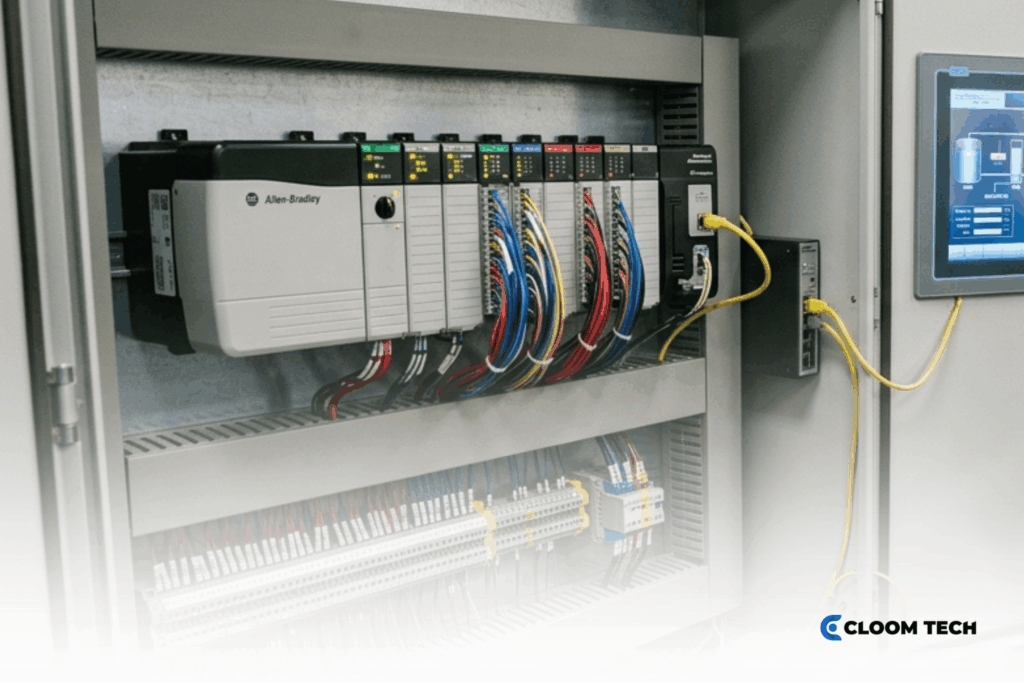
Modern operations across industries rely on automation architectures that shape performance and long-term scalability. The growing demand for flexibility has placed programmable logic controllers (PLCs) vs. PC-based control at the center of industrial automation decisions today.
PLC systems use dedicated hardware designed for deterministic control in harsh industrial environments. Computer control systems run on industrial PCs, allowing broader integration with software platforms and control programs across operations.
A poor choice between PLCs and computer control systems can increase downtime or limit scalability in practice. This guide walks through how each architecture works, a side-by-side comparison, the cost and reliability trade-offs, where each fits best, and when a hybrid approach makes more sense than either on its own.
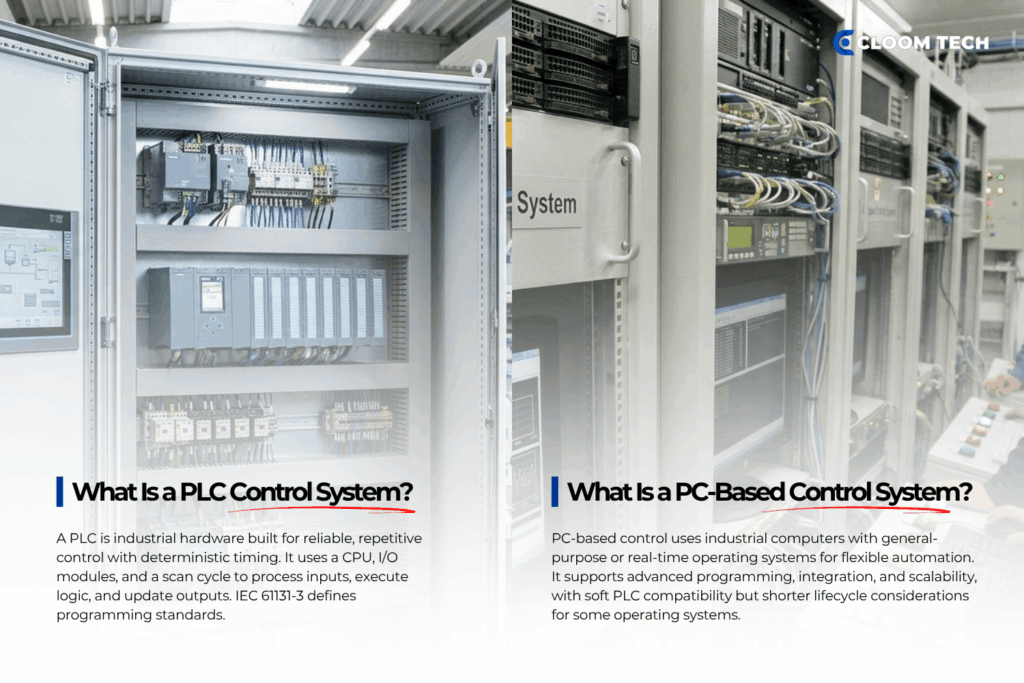
What is a PLC Control System?
A programmable logic controller (PLC) is purpose-built industrial hardware that executes repetitive control tasks with consistent timing under demanding conditions. Teams rely on a PLC control system when industrial processes require predictable responses and stable operation across varying loads.
A PLC uses a CPU, input and output modules, and a regulated power supply to process signals through a defined scan cycle. The CPU reads inputs from each sensor, executes control programs, and updates outputs within typical execution windows of 1 to 50 milliseconds, which delivers the deterministic response required by time-sensitive control tasks.
IEC 61131-3 defines PLC programming through ladder logic, structured text, and other standardized languages. Modern PLC platforms also support redundancy through hot-standby CPU configurations in critical infrastructure environments, and safety-certified variants meet IEC safety standards for high-reliability automation.
What is a PC-Based Control System?
PC-based control refers to computer control systems that use industrial hardware running a general-purpose or real-time operating system for automation tasks. Teams adopt PC-based control when applications demand flexibility and integration beyond traditional architectures.
Industrial PCs differ from standard PCs through rugged builds, extended temperature tolerance, and enhanced input and output capabilities, allowing deployment in conditions where conventional hardware cannot maintain stable performance. Event-driven programming lets developers use languages like C++ or .NET to implement complex control programs, while soft PLC layers support compliance with IEC standards and integration with existing automation workflows.
Operating system selection affects lifecycle planning, since Windows platforms typically have shorter support cycles than long-term industrial deployments require. Real-time OS configurations improve deterministic performance for high-demand processes.
PLC vs. PC-Based Control: Differences at a Glance
The application context determines the right architecture, since neither approach universally outperforms the other across all industrial scenarios. Engineers evaluating automation architectures must consider workload complexity, integration scope, and long-term operational constraints before selecting a solution.
PLC-based control systems deliver predictable execution through scan-cycle processing, supporting stable operation in time-sensitive environments with controlled variability. PC-based control supports event-driven multitasking and deterministic execution, which enables flexible handling of complex control applications under varying conditions.
| Factor | PLC Systems | PC-Based Control |
|---|---|---|
| Processing model | Scan-cycle deterministic execution | Event-driven and real-time execution models |
| Programming | IEC 61131-3 languages (e.g., ladder logic, structured text) | C++, Python, .NET, or soft-PLC |
| OS lifecycle | Embedded firmware or real-time OS | Windows LTSC or Linux RT lifecycle |
| Safety certification | Available with safety-rated PLC variants | Not inherently safety certified |
| Flexibility | Modular I/O expansion with a defined scope | Modular expansion with software-driven control |
| Integration | Field devices and higher-level systems | MES, ERP, SCADA, and cloud platforms |
| Typical lifespan | 15 to 20+ years with periodic firmware updates | 5 to 10 years with hardware refresh cycles |
| Upfront cost | Higher per-node investment | Lower hardware cost with higher software overhead |
Flexibility and Scalability
Flexibility and scalability determine how well a control architecture adapts to changing industrial requirements over time. Engineers must evaluate expansion limits and software adaptability before selecting a platform for evolving automation systems.
PLC systems excel at dedicated high-speed input and output tasks, which makes them reliable for tightly defined control operations. Modular architectures support expanded I/O and increased memory, often wired into the system through cable assemblies matched to the specific signal types running across the panel.
PC-based control scales through software updates, expanded storage, and hardware upgrades as processing demands increase. Adding machine vision or predictive analytics becomes more practical on a PC platform, since computing resources support integration across advanced control applications.
Cost Considerations: Upfront vs. Total Cost of Ownership
Cost evaluation must account for both initial investment and long-term impact across the full control system lifecycle. The total cost of ownership is usually more revealing than upfront pricing alone.
PLC systems carry higher hardware costs per unit, a reflection of their rugged build for continuous operation in demanding environments. Programming software may require licensing, though runtime environments are often bundled, which keeps PLC-based control systems competitive over a multi-year lifecycle.
PC-based control offers lower hardware costs but requires investment in operating system licensing and cybersecurity infrastructure during deployment. Hardware refresh cycles and IT maintenance drive up long-term costs, particularly when scaling industrial PCs across complex automation environments.
Reliability, Maintenance, and Cybersecurity
Industrial control systems demand reliability in harsh environments across service cycles. PLCs handle wide temperature ranges and resist vibration, supporting lifespans of over 20 years in facilities. Industrial PCs now approach similar durability through fanless designs and solid-state storage, though their operating systems introduce additional layers of risk.
Maintenance differs depending on the update frequency and structure. PLC firmware updates occur under controlled schedules, limiting runtime disruption. PC-based platforms require regular operating system patches, which can trigger instability or forced reboots.
Cybersecurity risks rise as operational systems connect to networks. PLCs have historically faced fewer direct threats due to their isolated deployment, though modern connected environments have changed that picture.
PC-based control inherits broader attack surfaces and typically requires additional safeguards such as antivirus protection, hardened operating system configurations, and TPM 2.0 modules in some deployments.
Integration with Modern Industrial Systems
Industrial control architectures depend on integration across operational technology and information technology layers. PLC systems directly connect to sensors and actuators, enabling coordinated motion control across 60 axes in demanding applications. PC-based control integrates with MES and ERP platforms, enabling data exchange with SCADA systems and cloud environments.
Modern PLC platforms now support database communication through built-in SQL capabilities and store-forward functions. Soft-PLC platforms combine deterministic control execution with PC-level connectivity, allowing unified hardware to manage control tasks and enterprise data exchange.
Regardless of which architecture you land on, signal integrity depends on the wiring behind it. You can request a free quote for custom wire harnesses and cable assemblies matched to your control system specifications, and we will respond within 12 hours.
When to Use a PLC vs. a PC-Based Control System
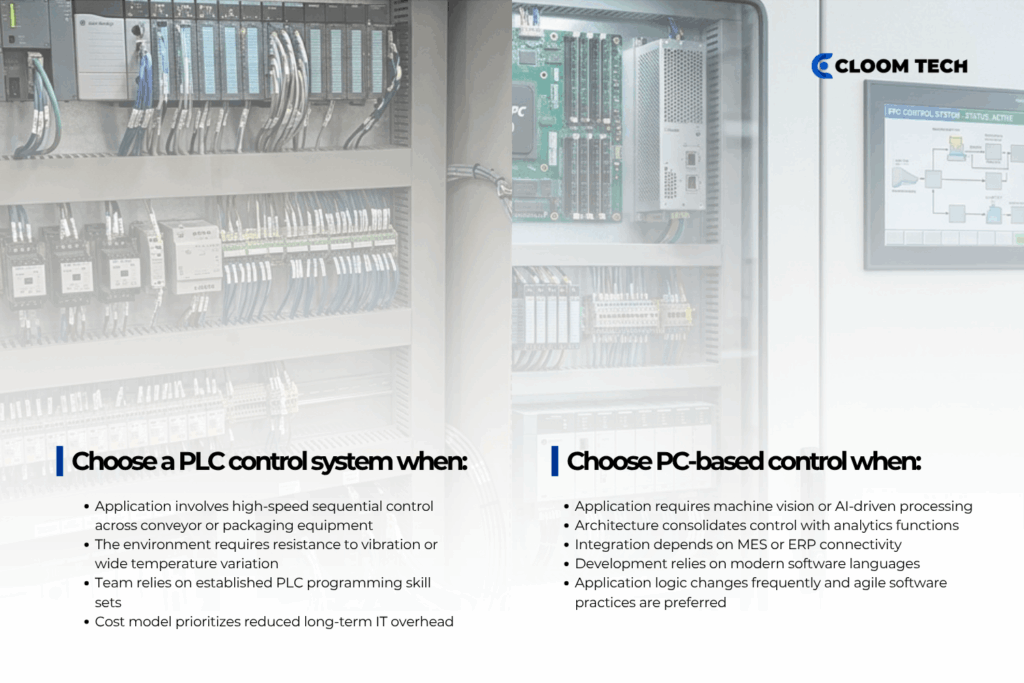
Application requirements determine whether a PLC control system or a PC-based control platform best meets operational demands. The control strategy depends on the workload type and the required determinism across machine processes. Engineering capability influences selection through expertise and expected software complexity.
Choose a PLC control system when:
- Application involves high-speed sequential control across conveyor or packaging equipment.
- The environment requires resistance to vibration or wide temperature variation.
- The team relies on established PLC programming skill sets.
- The cost model prioritizes reduced long-term IT overhead.
Choose PC-based control when:
- Application requires machine vision or AI-driven processing.
- Architecture consolidates control with analytics functions.
- Integration depends on MES or ERP connectivity.
- Development relies on modern software languages.
- Application logic changes frequently and agile software practices are preferred.
Hybrid Approaches: Combining PLC and PC-Based Control
Hybrid architectures divide deterministic control from higher-level computation across integrated system layers. PLCs manage machine-level execution, while industrial PCs handle visualization and data exchange across IT environments.
A robotic welding cell uses a PLC for axis coordination and safety interlocks, while an IPC runs vision inspection and transfers quality data to MES platforms. Soft-PLC platforms run IEC 61131-3 logic on industrial PC hardware using real-time operating systems.
Edge computing expands processing closer to machines, while AI integration increases automation capability across evolving industrial systems.
The Physical Layer Behind Every Control Decision
PLC versus PC-based is ultimately a software and architecture question, but neither platform performs the way its specifications promise without reliable wiring behind it. Sensors misread, actuators delay, and communication buses drop packets when harnesses are undersized, poorly shielded, or terminated inconsistently. The controller is only as good as the signals reaching it.
Cloom Tech manufactures custom wire harnesses and cable assemblies for PLC, PC-based, and hybrid control systems, built to IPC/WHMA-A-620 and ISO 9001 standards. Conductors, shielding, and termination methods are specified against the signal types and every assembly is 100% tested before shipment.
Specifying wiring for a new control system? Send us your drawings for a free manufacturing quote and a member of our team will respond within 12 hours.
PLC vs. PC-Based Control Systems FAQs
Can a PC replace a PLC in industrial automation?
PC-based control systems can replace PLCs in many industrial automation applications. Soft-PLC layers provide deterministic execution with support for real-time operating systems. Cycle times align with machine control requirements across most standard production environments.
Safety-certified applications still favor dedicated PLC hardware due to validated compliance frameworks. Long lifecycle installations rely on stable firmware support that reduces long-term operational risk.
Are PC-based control systems more expensive than PLCs?
Cost comparisons depend on total ownership rather than just initial hardware pricing. Industrial PCs often cost less upfront across equivalent performance classes. However, ongoing expenses include operating system licensing and cybersecurity management requirements. PLC systems avoid many IT overhead costs through simpler maintenance structures. Simpler control applications often benefit from lower lifecycle costs when using PLC-based architectures.
Is a hybrid PLC and PC-based system harder to maintain?
Not inherently, though it shifts the skill mix required across the maintenance team. Technicians still need PLC programming experience for the deterministic control side, while the PC layer adds Windows or Linux administration, cybersecurity management, and often SQL or middleware knowledge. Most facilities find the operational benefits of splitting deterministic control from higher-level computation outweigh the added skill requirements, but it’s worth budgeting for training or additional specialist support when planning the transition.
Can you migrate from a PLC to a PC-based control system without replacing the whole machine?
In many cases, yes. Soft-PLC platforms run IEC 61131-3 logic on industrial PC hardware, which means existing ladder logic and structured text programs can often be ported with limited rewriting. The bigger migration work usually sits on the I/O side, where field wiring, terminal blocks, and sensor interfaces may need to be reconfigured to match the new hardware. Phased migrations are common, with control logic moved first and I/O expansion or consolidation following over subsequent maintenance windows.
Back to Top: PLC vs. PC-Based Control Systems
