

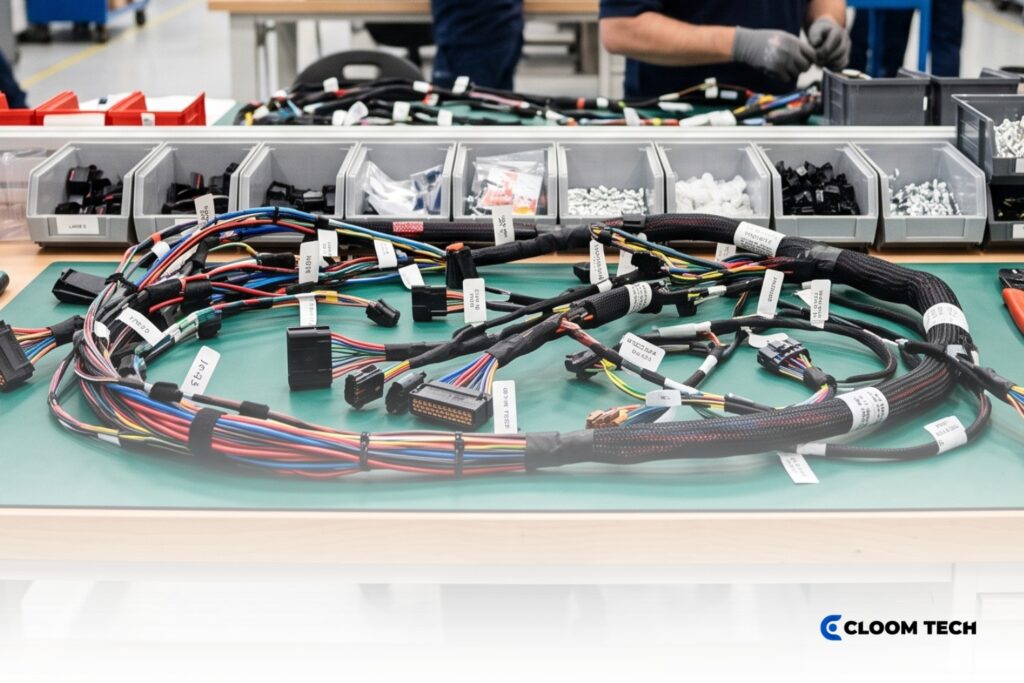
A motorcycle wire harness kit can serve a one-off repair or early experiment, yet production programs require a different level of control. Connector fit, branch lengths, circuit protection, and sealing must remain consistent across every unit. Modern platforms also rely on platform-compatible CAN communication, electronic control units (ECUs), and sensors, each with precisely defined connection requirements.
Custom batch manufacturing turns an approved electrical specification into repeatable assemblies with controlled materials, documented revisions, and defined tests. Original equipment manufacturer (OEM) teams must understand where kits fit and where they create production risk. A complete request for quotation (RFQ) supports the move from prototype validation to stable-volume manufacturing.
Plug-and-Play vs. Custom at a Glance

A motorcycle wire harness kit suits defined replacement tasks, while custom manufacturing supports repeatable production against an approved technical baseline. The choice affects far more than the initial purchase price because each route changes validation effort, installation time, and revision control.
| Production factor | Plug-and-play kit | Custom batch manufacturing |
|---|---|---|
| Batch consistency | Components and dimensions follow the kit supplier’s available configuration. | Every assembly follows the released drawing, bill of materials, and test requirements. |
| Electronics integration | Compatibility depends on the intended platform and supported communication protocol. | Pinouts, connectors, shielding, and branches match the customer’s approved electrical specification. |
| Environmental protection | Sealing and coverings come with the selected product. | Sealing, connector ratings, and coverings are specified and validated against the harness’s installed location and exposure. |
| Cost structure | Low initial commitment suits isolated units, although adaptation adds labor. | Setup and validation costs spread across the approved production quantity. |
| Lead time | Available products may ship quickly, subject to inventory and suitability. | Prototypes and production follow sourcing, review, approval, and manufacturing stages. |
| Change management | Supplier product changes may fall outside the buyer’s revision system. | Released revisions connect drawings, materials, instructions and inspection records. |
| Testing and traceability | Evidence varies by supplier and product. | The purchase specification can define electrical, mechanical and environmental acceptance evidence. |
A stocked kit may avoid initial setup charges, yet adaptation, additional hardware, and repeated inspection can raise installed cost. Custom production carries upfront review and validation effort, while an approved configuration reduces repeated interpretation on the assembly line. Buyers should compare both routes across the forecast quantity and expected revision life.
A custom motorcycle wire harness gives the OEM control over the approved configuration rather than forcing the platform around an available assembly. Experienced motorcycle wire harness manufacturers use customer documentation as the build reference and connect production records to that release.
When Kits Make Sense
Kits make sense when speed and unit-level convenience matter more than production repeatability. A one-off restoration, isolated replacement, or workshop modification may only need a compatible circuit layout and clearly labeled connections.
Early Prototype and Experimental Use
A motorcycle wire harness kit can also support an early bench experiment before the electrical architecture reaches release status. Engineers can use that temporary setup to check component interaction, establish packaging space, or gather information for the production specification. The kit remains an experimental tool rather than the controlled manufacturing baseline.
Physical Fit Still Requires Verification
Buyers still need to confirm connector compatibility, conductor size, circuit protection, and installation clearances. “Universal” describes a broad fit category rather than an automatic match for every mounting space, branch path, or terminal position.
Documentation and Quantity Considerations
Documentation deserves the same attention. A restoration shop can record any local adaptation for one machine, while an OEM must communicate the approved result across purchasing, production, and service teams. Temporary connections also need clear identification so experimental changes never enter a release package by assumption.
The economic case also changes with quantity. Adaptation time may remain acceptable for one motorcycle, while repeated trimming, splicing, or rerouting multiplies labor across a production batch. Once the same electrical configuration must recur, a released custom motorcycle wire harness provides a stronger basis for purchasing and assembly planning.
Where Kits Break Down for Production

Production exposes variations that a single successful installation may never reveal. Excess branch length leads to inconsistent routing, while mismatched connectors force the use of adapters or necessitate manual rework. Those differences affect assembly cycle time, inspection, and fault diagnosis across the line.
Platform-Specific Electrical Integration
A motorcycle wire harness kit may also carry circuits or protection features intended for another platform. Even when every connector physically mates, pin assignments and electronic behavior still require verification. Platform-compatible protocol behavior determines whether CAN-based functions operate, so physical connection alone cannot establish system compatibility.
Environmental Protection By Location
Motorcycles place electrical assemblies in environments with vibration, heat, moisture, dust, fuel, and oil. Protection needs to reflect the harness location and the OEM’s validation plan. OEMs can evaluate coverings with SAE J2192 physical-protection methods, while connectors require ratings that match their application conditions. Sealed automotive connector specifications can define temperature, vibration, and ingress-protection characteristics.
Standardized Installation Records
Standardized installation also depends on consistent labels, breakouts, retention points, and coverings. Manufacturing and inspection rely on engineering drawings and bills of materials alongside controlled work instructions. A kit that changes outside the OEM’s release process weakens that connection, even when each part appears serviceable.
What Custom Batch Manufacturing Changes
Custom batch manufacturing converts the OEM’s released information into a controlled production package. Wire types, terminals, seals, labels, breakouts, and coverings remain tied to the approved drawing and bill of materials.
Revision Control Across Production Functions
That control makes a custom motorcycle wire harness repeatable across purchasing, assembly, and inspection. Each accepted revision establishes what the factory builds, which parts purchasing sources, and which quality personnel perform the checks. Configuration management connects identification and change control with status accounting and configuration audits.
Environmental and Test Requirements
Environmental protection also becomes specification-driven. The OEM can define sealed connector families, abrasion protection, strain relief, and routing constraints for each location. Validation requirements can then address the actual exposure rather than relying on a generic “weatherproof” description.
Production testing follows the same principle. Continuity confirms circuit paths, while visual checks, crimp verification, and pull-force requirements address separate assembly characteristics. A layered acceptance plan can combine electrical and mechanical tests with connector inspection.
Defined test interfaces can also improve production flow. Mating fixtures and programmed test files reduce manual interpretation when connector positions and circuit maps stay stable. Serial labels or lot references then connect a finished assembly to its applicable material, inspection, and test records when the purchase specification requires traceability.
DFM Within Customer-Supplied Requirements
Qualified manufacturers also provide Design for Manufacturability (DFM) feedback without taking ownership of the electrical architecture. This review proactively identifies potential material, cost, and manufacturing concerns before committing to full-scale production against the approved print.
From Prototype to Production
The transition begins with a complete customer release, followed by DFM review and prototype manufacture. That sequence gives both parties a shared technical baseline before materials and factory instructions are scaled for a larger order.
Prototype Manufacture and Validation
For a custom motorcycle wire harness, the prototype should represent intended connectors, terminals, wire specifications, labels, and coverings wherever practical. The OEM then validates fit, routing, electrical behavior, service access, and applicable environmental performance on the target platform. Findings are returned through controlled drawing revisions and bill-of-material changes rather than informal shop-floor changes.
Prototypes typically take 2–3 weeks, depending on complexity and component sourcing. Production usually takes 4–5 weeks after the documentation, parts, and order requirements are supported for release. Those ranges guide planning rather than guaranteeing a delivery date for every program.
Release for Production
Approval should identify the accepted sample or first article, its drawing revision, and any authorized deviations. The production package then aligns purchasing, process instructions, test programming, and inspection records with that release. If a later change affects a connector, splice, or branch dimension, the engineering change order updates every affected record before implementation.
Controlled Changes During Ramp
Ramp planning should also define how the team handles component shortages and prototype substitutions. A temporary part can support evaluation only when its status remains visible in the documentation. Before volume release, purchasing and engineering confirm the approved production part, while the factory updates instructions and test interfaces that were affected by the substitution.
Throughout the ramp, the customer owns the specification, while the factory manufactures and tests against the approved release.
Preparing Your Specification for DFM Review
A manufacturing-ready specification defines what to build, how to verify it, and which requirements control acceptance. Drawings alone rarely communicate all the commercial and validation conditions that affect a quote.
Your package for a motorcycle wire harness should include:
- Electrical definition: Supply the schematic, pinout, circuit identification, conductor sizes, colors, and current requirements.
- Physical layout: State overall lengths, breakout positions, tolerances, routing constraints, retention points, and label locations.
- Component baseline: Identify connectors, terminals, seals, coverings, and approved manufacturer part numbers in the bill of materials.
- Operating exposure: Define temperature, vibration, moisture, chemical, abrasion, and service conditions by harness location.
- Acceptance requirements: List continuity limits, resistance checks, mechanical tests, environmental validation, and required records.
- Commercial scope: Provide prototype quantity, production volumes, forecasts, target dates, packaging needs, and delivery destination.
The documentation should distinguish fixed requirements from areas open to DFM feedback. The assembly still depends on customer approval for substitutions, dimensional changes, and architecture decisions. Manufacture-to-print production uses supplied technical documentation rather than transferring electrical-system development to the factory.
Complete inputs also help motorcycle wire harness manufacturers identify long-lead components, ambiguous tolerances, and test-equipment needs before quoting. Early clarification reduces later revision cycles without transferring specification ownership to the factory.
Discuss Your Motorcycle Harness Requirements with Cloom Tech
Cloom Tech manufactures custom motorcycle wire harnesses from customer-supplied drawings for motorcycle OEMs, aftermarket brands, electric scooters, and concept models. Our team provides DFM feedback on materials, manufacturability, and cost before producing prototypes in approximately 2–3 weeks. Full-volume production typically takes 4–5 weeks, depending on complexity, component sourcing, and order size.
Choose Cloom Tech when comparing motorcycle wire harness manufacturers for a manufacture-to-print program with ISO 9001 and IATF 16949 quality systems. We also apply IPC/WHMA-A-620 assembly requirements and support automated continuity testing across scalable production. Send us your drawings, bill of materials, expected volumes, environmental requirements, and test criteria, and we will get back to you with a quote within 12 hours.
Motorcycle Wire Harness Manufacturing FAQs
What minimum batch size makes custom manufacturing practical?
There is no universal break-even quantity because complexity, tooling, component minimums, testing, and forecast stability vary by program. Suppliers calculate batch economics based on the actual production package rather than a single industry-wide threshold.
Ask suppliers to separate nonrecurring setup charges from unit pricing, then compare total installed cost across the forecast. Suppliers can quote prototype, replacement, and OEM production runs against the requested quantity and release conditions.
How are engineering change orders managed?
An engineering change order should identify the requested change, the reason, affected part numbers, the new revision, the approval authority, and the implementation point. It should also address existing inventory, open orders, test programs, and previously manufactured assemblies.
Change control and status accounting operate alongside configuration audits. That structure helps buyers prevent a revised drawing from reaching production while purchasing or inspection still uses the earlier release.
Can one harness specification cover multiple motorcycle models?
One specification can cover several models when the shared circuits, connectors, and routing remain stable, and each permitted variant has unambiguous configuration rules. A 200% master arrangement may contain all content, while model-specific filters generate the applicable bill of materials and assembly definition.
Automotive platform development can use modular harnesses and configuration filters for vehicle variants. OEMs still need to evaluate added material, unused branches, and assembly complexity against the savings from common components.
What tests can be specified beyond continuity?
Additional tests can include insulation resistance, dielectric withstand, contact resistance, crimp pull force, terminal retention, and application-specific environmental validation. The test plan should connect each method to a defined limit, sample quantity, and acceptance decision.
Cable and harness validation can include insulation resistance and dielectric withstand voltage tests, although motorcycle OEMs should use requirements applicable to their product and market. Physical-protection validation may also address abrasion, vibration, or temperature exposure under a specified method rather than promising a universal service life.
How should OEMs plan cross-border logistics?
OEMs should compare landed costs, not just factory prices. Freight, insurance, duty classification, additional trade remedies, brokerage, inventory coverage, and expedited-shipping risk can change the sourcing result.
Section 301 duty treatment depends on the country of origin and tariff classification. Buyers sourcing from China or the Philippines should confirm the current Harmonized Tariff Schedule treatment for the specific assembly with a customs professional. Crucially, factory location alone does not guarantee a zero-duty outcome.
What should an RFQ include beyond drawings?
An RFQ should state the quotation assumptions that drawings cannot capture. These include tooling ownership, quote validity, payment terms, and responsibility for duties or freight. Buyers should also request price breaks, component lead times, approved-alternate rules, and the cost-effectiveness of later revisions.
These details let motorcycle wire harness manufacturers compare commercial risk against the same assumptions. For a motorcycle wire harness, the RFQ should also define confidentiality needs, first-article approval, and ownership of program-specific test fixtures.
Back to Top: Motorcycle Wire Harness Manufacturing: Custom vs. Plug-and-Play for OEMs
