

IEC and UL are different approaches that ensure safe, reliable electrical equipment. Both offer frameworks for meeting safety and performance requirements, but they target distinct regions and markets.
The International Electrotechnical Commission (IEC) develops global standards for electrical and electronic technologies. UL Solutions (formerly known as Underwriters Laboratory Inc.) is a North American organization that tests and certifies products for compliance with regional safety standards.
Panel builders, original equipment manufacturers, electrical engineers, and specifiers rely on these certifications to meet regulatory requirements, pass inspections, gain market access, and satisfy insurance conditions. Choosing the right path depends on the target market and compliance obligations.
IEC vs. UL: Standards Development and Product Certification
IEC and UL are organizations that influence product compliance and market access, but they serve different roles in the global standards ecosystem.
The International Electrotechnical Commission (IEC) develops international standards for electrical and electronic technologies, while Underwriters Laboratories (UL) develops standards and also certifies products against them.
That distinction matters because manufacturers may design equipment around IEC requirements, but market access and inspection approval often depend on certification from a recognized body.
IEC: International Standards Framework
The IEC is a non‑governmental organization that publishes international standards for electrical and electronic technologies. IEC guidelines cover safety, performance, and technical design across global markets. Manufacturers and regulators use these guidelines to build their equipment to meet consistent international expectations.
IEC standards provide specifications for:
- Electrical ratings such as voltage and current capacity.
- Environmental and operational conditions, including temperature ranges and performance criteria.
- Technical requirements that may support national regulations or international trade.
The IEC does not test or certify products itself. Manufacturers use IEC standards as a basis for design and compliance, and accredited third-parties perform testing and certification.
UL: Standards Development and Certification
UL is a U.S.-based safety organization that develops standards and tests products for compliance. Its listings and recognitions appear as marks on equipment, which inspectors in North America check to verify safety and regulatory compliance. Manufacturers and regulatory authorities rely on UL certifications to confirm that products meet defined safety and construction requirements.
UL certifications address the following areas:
- Safety and construction details, including component materials, insulation, and assembly practices.
- Ongoing factory audits and inspections required to maintain certification and ensure continuous compliance with UL standards.
In practical terms, IEC provides the standards framework, and UL may provide both the standard and the certification needed to prove compliance in North American and Canadian markets.
Technical Philosophy: Performance-Based vs. Prescriptive-Based
IEC and UL standards differ not only in scope but also in their underlying regulatory philosophy. IEC standards focus on verifying performance outcomes, while UL standards frequently specify detailed construction and safety requirements.
IEC’s Performance-Driven Approach
Many IEC product standards use a performance-based approach focused on how a product behaves under testing rather than prescribing exact construction methods. Manufacturers have flexibility as long as the equipment meets the required outcomes. This allows engineers to innovate while ensuring that products operate safely, reliably, and consistently in real-world conditions.
Performance-based testing includes:
- Use of metrics such as breaking capacity ratings for circuit breakers to confirm safe interruption of current.
- Ingress Protection (IP) ratings that evaluate resistance to dust, water, and environmental exposure.
- Verification of operational performance under specified electrical, thermal, or mechanical stresses to ensure consistent functionality.
UL’s Construction- and Safety-Focused Approach
UL takes a more prescriptive approach than many IEC product standards, specifying details such as creepage and clearance distances, material types, and component thickness, alongside performance tests.
Designers must follow these detailed construction and test requirements closely to ensure products pass UL safety evaluations and satisfy North American regulatory expectations.
UL testing:
- Confirms that products survive tests while remaining safe and fully functional.
- Evaluates enclosure safety, including fire resistance, corrosion protection, and environmental durability, beyond basic ingress protection.
Regional and Market Relevance
Different markets rely on different regulatory frameworks. Manufacturers must align with the standards that local authorities and inspectors recognize.
Where IEC Standards Dominate
IEC standards are widely recognized across Europe and in many international markets, where they serve as the default framework for electrical and electronic product safety and performance.
National regulations often reference IEC documents, making them a basis for compliance in multiple countries. If you build equipment for global export, following IEC standards simplifies market entry and reduces the need for separate testing or certification in each region.
Where UL Standards Are Essential
UL or equivalent standards are critical for products used in the U.S. and Canada, where regulatory authorities, inspectors, and insurers expect equipment to carry recognized UL marks. Compliance with these standards ensures products meet local safety and performance requirements and pass inspections without issues.
Meeting UL requirements involves several practical considerations for compliance and market acceptance:
- Align with local electrical codes, which frequently reference UL and CSA product standards as part of their technical requirements.
- Satisfy inspectors and insurers who check for UL Listings, Recognitions, or Classifications during approvals.
- Serve sectors where UL compliance is required, including commercial buildings, industrial plants, and data centers.
IEC vs. UL Differences at a Glance
| Aspect | IEC Standards | UL Standards |
|---|---|---|
| Role | Standards writer only | Standards writer and certifier |
| Philosophy | Performance-based, focuses on product behavior under test | Prescriptive, specifies construction and safety details |
| Geography | Global, widely adopted in Europe and many other markets | Primarily U.S. and Canada, widely recognized globally |
| Enclosure Ratings | IP ratings for dust and water | Includes fire, corrosion, and environmental protection |
| Breaker Ratings | Defined by performance metrics like breaking capacity | Defined by construction requirements and safety/performance tests (including interrupting ratings) |
| Certification Bodies | Independent certification bodies and labs | UL is both a certification body and test lab issuing UL Listing, Recognized, and Classified marks |
Factors to Consider When Choosing Between IEC vs UL
When you’re choosing between IEC and UL standards, you’ll need to evaluate regulatory, technical, and market factors. Engineers and specifiers can use this as a practical checklist to determine which framework aligns with target regions, compliance obligations, and internal risk management.
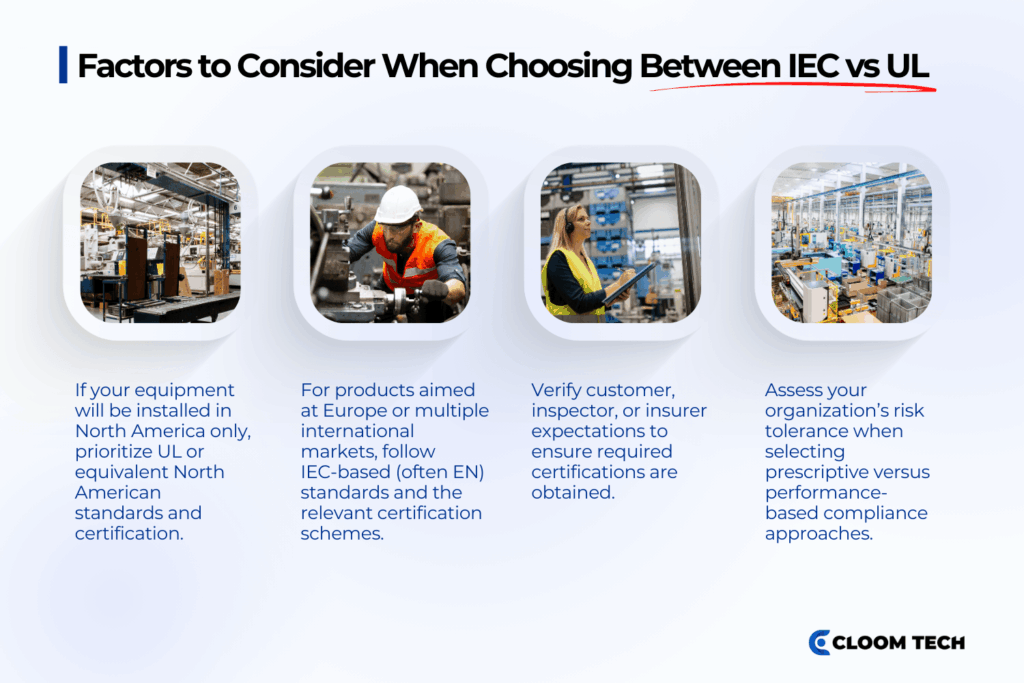
- If your equipment will be installed in North America only, prioritize UL or equivalent North American standards and certification.
- For products aimed at Europe or multiple international markets, follow IEC‑based (often EN) standards and the relevant certification schemes.
- Verify customer, inspector, or insurer expectations to ensure required certifications are obtained.
- Assess your organization’s risk tolerance when selecting prescriptive versus performance-based compliance approaches.
Choosing the Right Standard for Your Equipment
Choosing the correct standard directly impacts safety and compliance and determines where you can sell your equipment. Informed decisions reduce inspection failures and help products operate reliably under expected conditions.
Cloom Tech supports manufacturers by providing wire assemblies and cabling solutions tailored to meet both IEC and UL standards. Our precise production processes and rigorous testing help equipment maintain safety and regulatory compliance in global and North American markets.
For manufacturers supplying markets in both regions, it’s worth noting that our wire harnesses and cable assemblies are manufactured to ISO 9001 and IPC/WHMA-A-620 standards – giving you a solid compliance foundation whether you’re targeting North America, Europe, or both.
Contact us for dependable wire harness and cable assemblies that make certification easier and keep your equipment operating consistently in any installation.
IEC vs. UL FAQs
Can a product be certified to both IEC and UL standards?
Yes. Manufacturers can build and test products to meet IEC standards for international markets and UL standards for North America. Achieving both allows manufacturers to access multiple regions with the same equipment while maintaining compliance in each market.
How long does it take to obtain IEC or UL certification?
Certification timelines vary by product complexity, documentation completeness, and testing requirements. Simple equipment may take a few weeks, while more complex systems, such as control panels with multiple components, can require several months to complete evaluation and receive official approval.
What happens if my product fails IEC or UL testing?
A failed test isn’t the end of the road – it’s a diagnostic. Testing bodies typically provide a detailed report identifying exactly which requirements your product didn’t meet, whether that’s a construction detail, a performance threshold, or a documentation gap. From there, you redesign or adjust the relevant component, then resubmit for testing.
Back to Top: IEC vs. UL: Which One Do You Need?
