

Section 301 tariffs, reshoring mandates, and a reshaped global automotive supply chain have made manufacturing in Mexico vs. China a quarterly decision for procurement teams. Wire harness manufacturing sits at the center of that pressure.
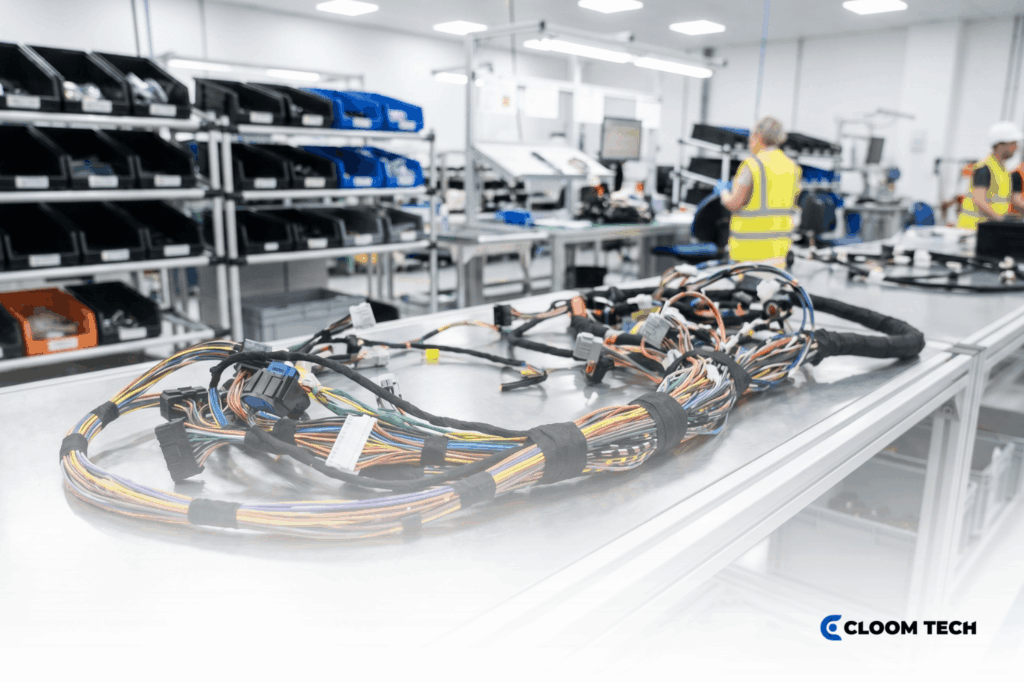
Harnesses are labor-intensive: connectors, terminals, and routing points are assembled by hand, with sheaths that bundle conductors and protect wires from friction and environmental damage. Labor cost is the dominant per-unit variable, and country of manufacture carries more financial weight here than in capital-intensive component categories.
Tariff Volatility Notice
Rate percentages in this article reflect the tariff structure at the time of writing and are illustrative of the framework. Significant new Section 301 actions and reciprocal tariff adjustments are in progress across multiple sourcing locations. Verify current applicable rates at ustr.gov and hts.usitc.gov before making sourcing or pricing decisions.
No single country wins across all volume tiers, program complexities, and tariff scenarios. China dominates at scale but carries the highest tariff exposure on US-bound shipments. The Philippines offers a tariff-mitigation pathway by avoiding China-specific Section 301 layers—though that advantage is under active policy review in 2026. Mexico delivers land-border speed for automotive programs, and the United States removes import tariff risk entirely at the highest labor cost.
Why Manufacturing Location Matters More Than It Did Five Years Ago
Five years ago, wire harness and cable assembly sourcing decisions largely turned on labor costs. Today, tariff structure, treaty risk, and reshoring policy carry equal weight – and all three are in motion simultaneously.
The reshoring shift
The Reshoring Initiative’s data shows tariffs as a primary motivating factor behind the acceleration of reshoring and near-shoring activity in recent years, with manufacturing jobs returning to the United States at a rate not seen since the 2000s. The push to nearshore wire harness programs is accelerating alongside growth in vehicle electrical system complexity. Modern platforms carry thousands of part numbers routed through multi-branch architectures, and demand from industrial end-users in automation and medical equipment is extending that growth beyond automotive.
The Policy Risk Landscape in 2026
Four active policy developments are reshaping the landed cost calculation across all four countries in this comparison:
- The USMCA is undergoing its scheduled six-year joint review in 2026. The Center for Strategic and International Studies assesses a clean extension as unlikely, directly affecting procurement decisions for Mexico-sourced harnesses.
- USTR has issued actionability findings related to Section 301 forced-labor concerns against Mexico, with formal hearings scheduled for July 7, 2026.
- USTR’s June 2, 2026 forced-labor Section 301 investigation covers 60 economies, including the Philippines. USTR has proposed additional duties of 12.5% on Philippines-origin goods (Tier 2 classification). This is not yet finalized—public comments closed July 6, 2026, with hearings on July 7, 2026. Monitor ustr.gov for the final determination.
- Section 232 tariffs on steel, aluminum, and copper were restructured in 2026, with duties now assessed on the full customs value. Primary metal articles carry a 50% rate; many derivative products carry 25%, with select categories at 15% effective June 8, 2026. For wire harnesses under HTS 8544, applicability depends on metal content and classification – verify with a licensed customs broker.
Four-Country Comparison at a Glance
Use this table to assess each country against your program’s volume tier, tariff exposure, certification requirements, and lead-time constraints. Any column that disqualifies a country removes it from consideration before a full cost comparison is needed.
| Country | Relative Labor Cost Index (China = 100) | Section 301 Tariff Exposure | Typical Lead Time (Mass Production) | Primary Certification Depth |
|---|---|---|---|---|
| China | 100 (baseline) | Yes – Section 301 applies at 25% on HTS 8544.30, plus base MFN 5% | 4–5 weeks | IATF 16949, ISO 9001, ISO 13485 |
| Philippines | ~85–95 | Lower current exposure avoids China-specific Section 301 and pays MFN plus reciprocal rates. Proposed 12.5% forced-labor overlay not yet finalized (July 2026 hearing). | 5–6 weeks | ISO 13485, ISO 9001 (confirm IATF 16949 with client) |
| Mexico | ~110–130 | USMCA framework (75% RVC + 40% LVC required). Tariff position under active review mid-2026. Proposed Section 301 forced-labor action. Verify with the customs broker. | 4–6 weeks | IATF 16949 (automotive ecosystem) |
| USA | ~300–450 | None – domestic manufacture | 2–3 weeks | All major certifications |
Disclaimer: The labor cost index is relative to the China baseline (China = 100) using ILO/World Bank manufacturing wage data. Per-circuit unit cost varies by circuit count, wire gauge, connector specification, termination type, and testing requirements—a program-specific quote is required. Contact our team for a program-specific cost comparison.
How to read this table
Read across each row to assess a country against your program’s four constraints. The labor cost index is directional, not a total landed cost figure. A country with a higher labor index can still deliver a lower total landed cost when tariff exposure at the origin point is elevated—as the China vs. Philippines comparison illustrates at most volume tiers.
- Section 301 tariff exposure: China carries the full legacy stack. The Philippines carries lower overall exposure under current rules, with a proposed 12.5% forced-labor overlay not yet finalized. Mexico’s USMCA-based preferential position is under active review.
- Certification depth: IATF 16949 for Tier 1 automotive, ISO 13485 for medical device, and ISO 9001 as the cross-industry baseline.
Where China Wins for Wire Harness Manufacturing
At high volume, China’s structural advantages in supply chain integration outweigh its tariff exposure for most Western OEM programs. The prerequisite is to model the duty liability into the total landed cost from the start, rather than treating it as an afterthought.
Supply ecosystem depth
China’s wire harness industry is the most vertically integrated globally. Leading harness assemblers operate alongside copper wire drawers, connector stampers, and overmolding specialists within the same industrial zones. That proximity compresses component lead times and bulk procurement costs in ways that geographically dispersed supply chains struggle to replicate. Material procurement prices are structurally difficult to match in markets with shallower supplier bases.
Volume tier economics
The financial case for China sourcing shifts materially by program volume:
- 1,000 units: China’s combined duty of approximately 30% (5% MFN plus 25% Section 301) can erode the labor-cost advantage over a Philippines-origin alternative at this tier.
- 10,000 units and above: Bulk procurement leverage on copper, terminals, and connectors typically delivers the lowest unit cost before tariffs. China’s supply ecosystem advantage outweighs the tariff differential at this scale.
- 100,000 units: Amortized tooling and dedicated line capacity drive per-unit cost to its floor. Absolute tariff exposure is also highest at this scale, making a dual-source strategy most financially compelling.
China’s average manufacturing wage has risen approximately 5% annually since 2020. At sub-10,000-unit volumes, the wage growth narrows the cost margin at a point where tariff costs are proportionately higher.
The duty liability reality
For a $50,000 China-origin wire harness shipment under HTS 8544.30, the duty structure is 5% base MFN plus 25% Section 301, confirmed by CBP and USTR published schedules. The combined effective rate of approximately 30% implies a duty liability of $15,000 on that shipment. Correct HTS classification is a prerequisite for that calculation; misclassification carries underpayment penalties or overpayment across a program’s entire production life. Verify current rates at the tariff schedule before finalizing any cost model.
If your program requires a cost estimate across sourcing locations, request a quote from our team to compare China-origin and dual-source scenarios side by side.
Where the Philippines Wins for Wire Harness Manufacturing
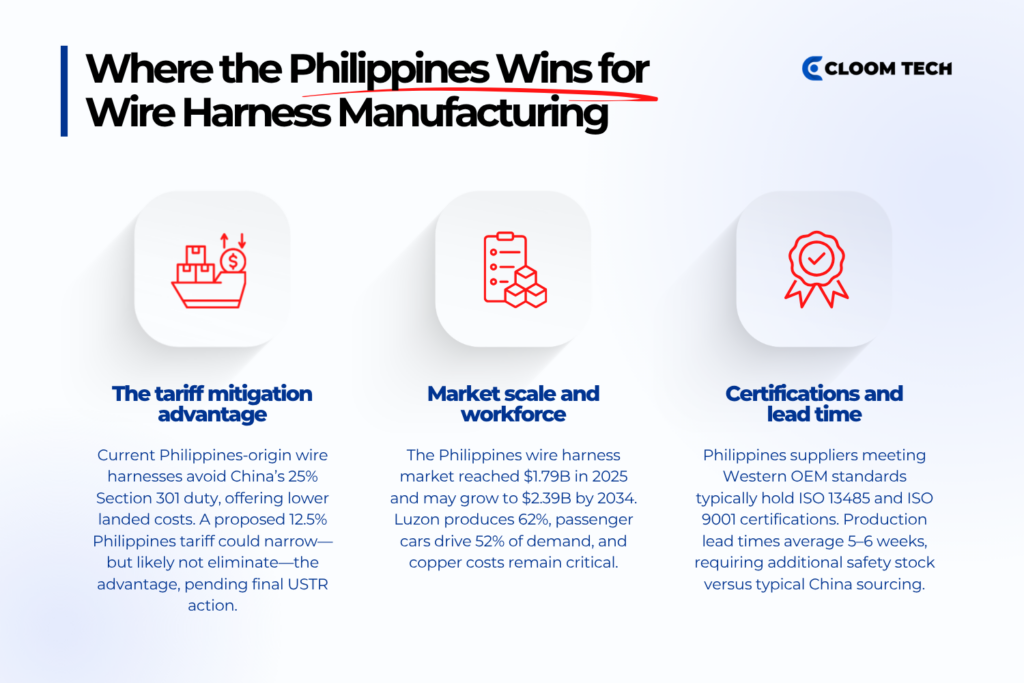
The Philippines’ primary tariff advantage over China is structural: Philippines-origin goods are not subject to the China-specific Section 301 framework, which adds 25 percentage points to the duty rate on HTS 8544.30 China-origin harnesses. That differential is real and significant—but it is under active policy review as of mid-2026.
The tariff mitigation advantage
Philippines-origin wire harnesses classified under HTS 8544.30 currently pay only the MFN base rate plus applicable reciprocal tariffs. For US-bound programs managing China-specific Section 301 exposure, that structure delivers a meaningfully lower blended duty rate.
The active development to monitor: On June 2, 2026, USTR proposed additional Section 301 duties covering 60 economies, including the Philippines. The Philippines falls in the Tier 2 classification, with a proposed additional rate of 12.5%. If finalized, Philippines-origin harnesses would face MFN base rate plus reciprocal tariffs plus 12.5%—narrowing (but likely not eliminating) the differential versus China at most program scales. The public comment period closed July 6, 2026, with a USTR hearing on July 7, 2026. No final determination had been issued at the time of writing. Monitor the latest status at the U.S. Trade Representative before finalizing any cost model that relies on the Philippines’ tariff advantage.
On a $50,000 shipment under current rates, a China-origin harness carries combined duties of approximately $15,000. A Philippines-origin harness under the same HTS code pays MFN base rate plus applicable reciprocal tariffs—without the 25% Section 301 layer. At scale, that differential remains compelling even if the proposed 12.5% overlay is finalized, depending on program volume and HTS classification.
Market scale and workforce
The Philippines’ automotive wire harness market reached approximately $1.79 billion in 2025, with projected annual growth toward $2.39 billion by 2034. Luzon accounts for approximately 62% of the Philippines’ wire harness production. Passenger car programs represent approximately 52% of end-market demand. Copper accounts for approximately 86% of wire harness material input by value, making copper tariff changes (Section 232, 2026) a cost factor across all manufacturing locations, including the Philippines.
Certifications and lead time
Philippines facilities at Western OEM quality levels hold ISO 13485 and ISO 9001 certifications, covering medical device and general industrial programs. Typical mass production lead time is 5–6 weeks—one to two weeks longer than a China cycle. Factor this into safety stock planning when evaluating the Philippines as a primary or secondary source.
Where Mexico Wins for Wire Harness Manufacturing
Mexico’s primary advantage is time, not cost. Land-border access to the United States cuts ocean transit by approximately one week, directly reducing safety stock requirements and replenishment cycle times for North American programs.
Logistics proximity
Manufacturing in Mexico puts harnesses on the road, with delivery to US facilities in 1–2 weeks versus 2–3 weeks by ocean freight. Programs that depend on lean replenishment or fast engineering-change response benefit most from that proximity. Safety stock requirements drop and just-in-time replenishment becomes achievable at that lead time.
Automotive ecosystem depth
Mexico’s automotive manufacturing sector has deep IATF 16949 certification penetration, reflecting decades of investment by global automotive suppliers across Sonora, Chihuahua, and Nuevo León. Major international wire harness producers have built substantial operations there, making it a primary location for assemblies serving North American automotive programs.
The USMCA tariff framework and its current risks
Mexico-origin wire harnesses can qualify for preferential duty treatment under USMCA if they meet the applicable rules of origin:
- 75% Regional Value Content (RVC) required
- 40% Labor Value Content (LVC) for workers earning at least $16 per hour
- Non-USMCA-sourced inputs must remain below the 10% de minimis threshold by transaction value
Mexico Tariff Risk – Verify Before Committing
The USMCA preferential architecture is under active review as of mid-2026. USTR has opened a Section 301 forced-labor investigation against Mexico (hearings July 7, 2026). An adverse finding could translate into sector-specific tariffs that override USMCA duty-free protections. Verify current eligibility and risk profile with a licensed customs broker before making sourcing commitments based on USMCA assumptions.
Labor cost reality
Mexico costs more than China on labor, with the index sitting at approximately 110–130 on the China-baseline scale. Mexico is not the right choice where labor cost savings are the primary objective. The case for Mexico rests on logistics speed and USMCA access, not wage rates.
Where the USA Wins for Wire Harness Manufacturing
Domestic manufacturing eliminates the import tariff variable entirely. For programs where tariff volatility or domestic content requirements are the primary constraints, that trade-off often outweighs the labor cost premium.
The zero-tariff trade-off
US-manufactured harnesses eliminate Section 301 risk, MFN duty liability, USMCA qualification risk, and customs compliance overhead in a single sourcing decision. Typical mass production lead time is 2–3 weeks. The trade-off is labor cost: the US index sits at approximately 300–450 on a China-baseline scale.
When domestic sourcing is non-negotiable
Several program conditions make US sourcing a qualification requirement rather than a preference:
- IRA and CHIPS Act programs: Domestic content requirements may mandate US-sourced harnesses for OEM customers in electric and hybrid vehicles, energy storage, or semiconductor-adjacent applications.
- Electronics manufacturing programs with rapid iteration cycles benefit from domestic proximity, where engineering changes move without international freight delays.
- R&D collaboration benefits from shared time zones and direct facility access.
Certifications and cost profile
US-based manufacturers hold the full certification range – IATF 16949, ISO 9001, ISO 13485, UL/CSA, and IPC/WHMA-A-620 – and operate under direct regulatory jurisdiction. That simplifies supplier qualification audits for OEMs with stringent approval processes. The labor cost premium is most easily absorbed on low-volume, high-complexity, or urgency-driven programs.
The Dual-Source Split: What the Data Suggests for Most Western OEM Programs
For most Western OEM programs running between 10,000 and 100,000 units annually, a dual-source split is the optimal structure. China’s bulk procurement economics hold for the majority of the volume, while a Philippines-origin share routes through a lower blended duty lane—diversifying the tariff risk that a single-origin model leaves exposed.
The 60/40 model
A split of approximately 60–70% China and 30–40% Philippines delivers a risk-diversified structure within a manageable supplier relationship:
- China’s bulk procurement economics hold for the majority volume, preserving the material cost advantages that make China competitive at scale.
- The Philippines-origin portion avoids the China-specific Section 301 layer under current rules, reducing the program’s blended duty rate.
- The blended duty rate decreases as the Philippines-origin share increases. That ratio can be modeled precisely for any program once both location costs are known.
Note on the Philippines 12.5% Proposed Duty
If USTR finalizes the proposed 12.5% forced-labor overlay on Philippines-origin goods, the blended duty advantage of the 60/40 split narrows but does not disappear for most programs. Model both scenarios – with and without the proposed 12.5% – when building 2026–2027 cost forecasts. The final determination timeline is July 2026.
Volume thresholds
- Below 1,000 units annually: tooling duplication costs typically outweigh tariff savings. Single-source from the Philippines or the USA is usually more cost-effective.
- 10,000–100,000 units: the 60/40 China-Philippines split is the most financially compelling structure for most Western OEM programs.
- Mexico-dominant programs: most compelling where land-border logistics speed and IATF 16949 certification depth are the dominant requirements.
Tooling and specification alignment
Dual-source programs require tooling alignment before production launch, and that investment should be factored into the tariff savings calculation from the outset. Crimp tooling, mold tooling, and test fixtures must be either duplicated across both suppliers or transferred under a documented ownership agreement. Wire gauge specifications, connector series selections, and routing documentation must align precisely—specification drift produces non-interchangeable assemblies and defeats the risk-diversification objective.
For a structured breakdown of how to qualify and manage a dual-source wire harness program, see our [INTERNAL LINK: Dual Sourcing for Wire Harness Manufacturing – CT-JUN-04 – add URL when live].
How Cloom Tech Compares Wire Harness Programs Across All Four Locations
At Cloom Tech, we operate manufacturing facilities in both China and the Philippines, giving OEM procurement teams a first-party comparison of program costs, lead times, and certification profiles across both locations within a single supplier relationship.
Our China facility
Our China facility supports the volume, certification, and supply chain depth required by high-complexity programs:
- High-volume programs requiring IATF 16949, ISO 9001, ISO 13485, and IPC/WHMA-A-620 certification depth.
- Established bulk procurement channels for copper wire, terminals, and connectors—generating material cost advantages at scale.
- Full wire harness production from routing through termination and testing, built to client-supplied specifications.
- Design for Manufacturability (DFM) feedback on existing client designs—optimized for the manufacturing techniques at each facility. DFM is feedback on pre-existing designs; it is not ground-up engineering.
- Customized solutions built to your circuit count, connector specification, and testing protocol.
Our Philippines facility
Our Philippines facility extends the dual-source model into a lower blended duty lane while maintaining the documentation consistency OEMs need across both locations:
- Programs requiring ISO 13485 and ISO 9001 certification.
- 5–6-week mass-production lead time.
- Lower duty exposure versus China-origin goods under current rules – avoiding the legacy China-specific Section 301 stack, with MFN plus reciprocal rates applying instead. Note: The proposed USTR 12.5% forced-labor overlay (not yet finalized) would affect this calculation if implemented.
- OEM customers implementing a dual-source split can model blended duty scenarios across both locations through a single supplier relationship, cutting qualification and audit overhead.
For a complete supply chain risk management framework – covering dual sourcing, geographic diversification, safety stock, and supplier qualification depth – see our [INTERNAL LINK: Supply Chain Risk Management Playbook – CT-JUN-03 – add URL when live].
Every wire harness program has a unique cost profile. Contact our team for a total landed cost comparison across sourcing locations.
FAQs on China vs. Philippines vs. Mexico vs. USA
What happens to the Philippines’ tariff advantage if the proposed 12.5% duty is finalized?
If implemented, Philippines-origin harnesses would face an additional 12.5% duty on top of current MFN plus reciprocal rates. For reference, China-origin harnesses carry an additional 25% Section 301 on top of MFN—so even with a 12.5% overlay, a differential would likely remain for most programs. The final rate, scope, and effective date are not yet determined. Model both scenarios when building 2026–2027 cost forecasts, and verify the final determination at ustr.gov.
How much does it cost to qualify a second supplier?
Qualifying a new supplier typically takes 4–9 months and can cost $25,000–$80,000 or more, depending on program complexity. This includes PPAP, tooling validation, first-article inspection, and ongoing audit costs. These costs are often underestimated when companies pursue dual sourcing primarily for tariff reasons; build them into the savings calculation from the start.
When does managing multiple suppliers stop being worth it?
Most programs find that managing more than two qualified suppliers becomes inefficient below roughly 8,000–10,000 units per supplier per year. Above 15,000–20,000 units annually, the tariff savings and risk diversification benefits of a well-managed dual-source strategy typically justify the added complexity for most Western OEM programs.
Does Cloom Tech manufacture in Mexico or the USA?
Our manufacturing operations are in China and the Philippines. For programs where Mexico or US sourcing is a requirement, we can provide a cost and capability comparison across all four locations to help you evaluate the right structure for your program. Contact our team to discuss your program requirements.
Back to Top: China vs. Philippines vs. Mexico vs. USA: Where Each Country Wins for Wire Harness Manufacturing
